MCQ
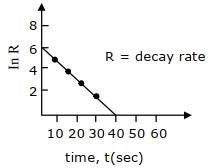
For a certain radioactive process the graph between $In\, {R}$ and ${t}\,({sec})$ is obtained as shown in the figure. Then the value of half life for the unknown radioactive material is approximately $....\,{sec}.$
  • A
    $6.93$
  • $4.62$
  • C
    $2.62$
  • D
    $9.15$

Answer

Correct option: B.
$4.62$
b
${R}=R_{o} e^{-\lambda t}$

$\ell n R=\ell n R_{o}-\lambda t$

$-\lambda$ is slope of straight line

$\lambda=\frac{3}{20}$

$t_{1 / 2}=\frac{\ell n 2}{\lambda}=4.62$

Need a full question paper?

Generate a complete, print-ready paper with questions like this in minutes — across 16+ boards, with answer keys.

Start Generating Free

Similar questions

Match List$-I$ with List$-II$

List$-I$ List$-II$
$(a)$ Isothermal $(i)$ Pressure constant
$(b)$ Isochoric $(ii)$ Temperature constant
$(c)$ Adiabatic $(iii)$ Volume constant
$(d)$ Isobaric $(iv)$ Heat content is constant

Choose the correct answer from the options given below

The electric fields of two plane electromagnetic plane waves in vacuum are given by

$\overrightarrow{\mathrm{E}}_{1}=\mathrm{E}_{0} \hat{\mathrm{j}} \cos (\omega \mathrm{t}-\mathrm{kx})$ and

$\overrightarrow{\mathrm{E}}_{2}=\mathrm{E}_{0} \hat{\mathrm{k}} \cos (\omega \mathrm{t}-\mathrm{ky})$

At $t=0,$ a particle of charge $q$ is at origin with a velocity $\overrightarrow{\mathrm{v}}=0.8 \mathrm{c} \hat{\mathrm{j}}$ ($c$ is the speed of light in vacuum). The instantaneous force experienced by the particle is 

It is preferable to measure the $e.m.f.$ of a cell by potentiometer than by a voltmeter because of the following possible reasons.
$(i)$ In case of potentiometer, no current flows through the cell.
$(ii)$ The length of the potentiometer allows greater precision.
$(iii)$ Measurement by the potentiometer is quicker.
$(iv)$ The sensitivity of the galvanometer, when using a potentiometer is not relevant.
Which of these reasons are correct?
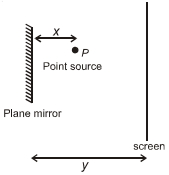
Shape of interference fringes formed on the screen due to point source $P$, in the case shown here
A sphere, a cube and a thin circular plate, all made of the same mass and finish are heated to a temperature of $200^{\circ} C$. Which of these objects will cool slowest, when left in air at room temperature?
There is a current of $1.344\, amp$ in a copper wire whose area of cross-section normal to the length of the wire is $1\,m{m^2}$. If the number of free electrons per $c{m^3}$ is $8.4 \times {10^{22}}$, then the drift velocity would be
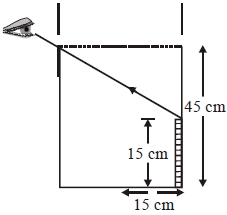
An observer can see through a small hole on the side of a jar (radius $15\, cm$ ) at a point at height of $15\, cm$ from the bottom (see figure). The hole is at a height of $45\, cm$. When the jar is filled with a liquid up to a height of $30\, cm$ the same observer can see the edge at the bottom of the jar. If the refractive index of the liquid $N / 100,$ where $N$ is an integer, the value of $N$ is $.....$
The wavelength of maximum intensity of radiation emitted by a star is $289.8 \,nm$. The radiation intensity for the star is : (Stefan’s constant $5.67 \times {10^{ - 8}}W{m^{ - 2}}{K^{ - 4}}$, constant $b = 2898\mu mK)$
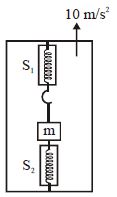
Reading shown in two extended spring balances, $S_1$ and $S_2$ is $60\,kg$ and $30\,kg$ respectively and lift is accelerating upward with acceleration $10\, m/s^2.$ The mass is stationary with respect to lift. Then the mass of the block will be  ......... $kg$.
A $10\,\mu F$ capacitor and a $20\,\mu F$ capacitor are connected in series across a $200\;V$ supply line. The charged capacitors are then disconnected from the line and reconnected with their positive plates together and negative plates together and no external voltage is applied. What is the potential difference across each capacitor