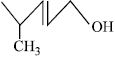
MCQ
For a $d$ electron, the orbital angular momentum is
  • $\sqrt {6\hbar } $
  • B
    $\sqrt {2\hbar } $
  • C
    $\hbar $
  • D
    $2\hbar $

Answer

Correct option: A.
$\sqrt {6\hbar } $
a
We know that the orbital angular momentum $(L)=\sqrt{1(1+1)} \frac{h}{2 \pi}$

For $d -$ orbital, $1=2$

Thus, the orbital angular momentum is $=\sqrt{6} \frac{ h }{2 \pi}$

$\sqrt {6\hbar } $

Need a full question paper?

Generate a complete, print-ready paper with questions like this in minutes — across 16+ boards, with answer keys.

Start Generating Free

Similar questions

Ammonia gas dissolves in water to form $N{H_4}OH$. In this reaction water acts as
The number of complexes from the following with no electrons in the $t_2$ orbital is. . . . . . . $\mathrm{TiCl}_4,\left[\mathrm{MnO}_4\right]^{-},\left[\mathrm{FeO}_4\right]^{2-},\left[\mathrm{FeCl}_4\right]^{-},\left[\mathrm{CoCl}_4\right]^{2-}$
When a metal rod ${M}$ is dipped into an aqueous colourless concentrated solution of compound ${N}$, the solution turns light blue. Addition of aqueous $\mathrm{NaCl}$ to the blue solution gives a white precipitate ${O}$. Addition of aqueous $\mathrm{NH}_3$ dissolves ${O}$ and gives an intense blue solution.

$1.$ The metal rod ${M}$ is

$(A)$ $\mathrm{Fe}$ $(B)$ $\mathrm{Cu}$ $(C)$ $\mathrm{Ni}$ $(D)$ $\mathrm{Co}$

$2.$ The compound ${N}$ is

$(A)$ $\mathrm{AgNO}_3$ $(B)$ $\mathrm{Zn}\left(\mathrm{NO}_3\right)_2$

$(C)$ $\mathrm{Al}\left(\mathrm{NO}_3\right)_3$ $(D)$ $\mathrm{Pb}\left(\mathrm{NO}_3\right)_2$

$3.$ The final solution contains

$(A)$ $\left[\mathrm{Pb}\left(\mathrm{NH}_3\right)_4\right]^{2+}$ and $\left[\mathrm{CoCl}_4\right]^{2-}$

$(B)$ $\left[\mathrm{Al}\left(\mathrm{NH}_3\right)_4\right]^{3+}$ and $\left[\mathrm{Cu}\left(\mathrm{NH}_3\right)_4\right]^{2+}$

$(C)$ $\left[\mathrm{Ag}\left(\mathrm{NH}_3\right)_2\right]^{+}$and $\left[\mathrm{Cu}\left(\mathrm{NH}_3\right)_4\right]^{2+}$

$(D)$ $\left[\mathrm{Ag}\left(\mathrm{NH}_3\right)_2\right]^{+}$and $\left[\mathrm{Ni}\left(\mathrm{NH}_3\right)_6\right]^{2+}$

Give the answer question $1,2$ and $3.$
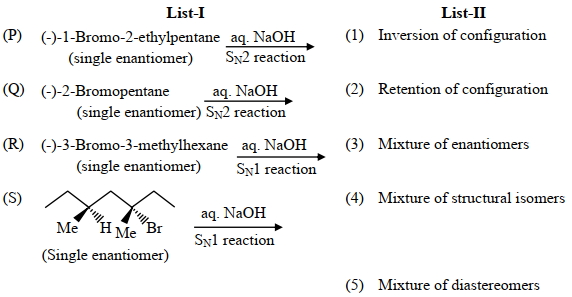
Match the reactions in List-$I$ with the features of their products in List-$II$ and choose the correct option.
$1$ mol of $C{H_4}$contains
Which of the following is not correct regarding basic strength?
Grignard reagent is a
An organic compound contains $C,$ $H$ and $S$. The minimum molecular weight of the compound containing  $8\%$ sulphur is........$g\,mo{l^{ - 1}}$  (atomic weight of  $S = 32\,amu$ )
Among the following, the compound that undergoes nitration readily is
$IUPAC$ name of the below compound is :