Question
Match the thermodynamic processes taking place in a system with the correct conditions. In the table: $\Delta Q$ is the heat supplied, $\Delta W$ is the work done and $\Delta U$ is change in internal energy of the system
Process Condition
$(I)$ Adiabatic $(A)\; \Delta W =0$
$(II)$ Isothermal $(B)\; \Delta Q=0$
$(III)$ Isochoric $(C)\; \Delta U \neq 0, \Delta W \neq 0 \Delta Q \neq 0$
$(IV)$ Isobaric $(D)\; \Delta U =0$

Answer

$(I)$ Adiabatic process $\Rightarrow \Delta Q=0$ No exchange of heat takes place with surroundings

$(II)$ Isothermal proess $\Rightarrow$ Temperature remains constant $(\Delta T =0)$

$\Delta u =\frac{ F }{2} nR \Delta T \Rightarrow \Delta u =0$

No change in internal energy $[\Delta u =0]$

$(III)$ Isochoric process Volume remains constant

$\Delta V =0$

$W =\int P \cdot d V =0$

Hence work done is zero.

$(IV)$ Isobaric process $\Rightarrow$ Pressure remains constant

$W = P . \Delta V \neq 0$

$\Delta u =\frac{ F }{2} nR \Delta T =\frac{ F }{2}[ P \Delta V ] \neq 0$

$\Delta Q = n C _{ p } \Delta T \neq 0$

Need a full question paper?

Generate a complete, print-ready paper with questions like this in minutes — across 16+ boards, with answer keys.

Start Generating Free

Similar questions

If a particle of mass $m$ is moving with constant velocity $v$ parallel to $X-$axis in $x-y$ plane as shown in fig. Its angular momentum with respect to origin at any time $t$ will be
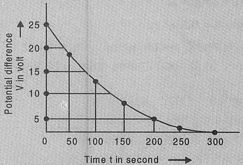
The figure shows an experimental plot for discharging of a capacitor in an $R-C$ circuit. The time constant $\tau$ of this circuit lies between
A particle of mass $m$ moves in a circular orbit in a central potential field $U ( r )= U _{0} r ^{4}$. If Bohr's quantization conditions are applied, radii of possible orbitals $r _{ n }$ vary with $n ^{1 / \alpha}$, where $\alpha$ is ....... .
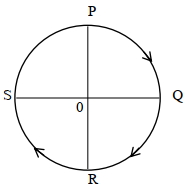
A cyclist starts from the point $P$ of a circular ground of radius $2 \mathrm{~km}$ and travels along its circumference to the point $\mathrm{S}$. The displacement of a cyclist is:
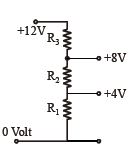
A potential divider is used to give outputs of $4\,V$ and $8\,V$ from a $12\,V$ source. Which combination of resistances, $(R_1 : R_2 : R_3)$ gives the correct voltages
Two metallic plates form a parallel plate capacitor. The distance between the plates is $'d'.$ A metal sheet of thickness $\frac{d}{2}$ and of area equal to area of each plate is introduced between the plates. What will be the ratio of the new capacitance to the original capacitance of the capacitor $?$
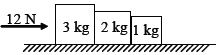
Three blocks of masses $3\, kg, 2\, kg$ and $1\, kg$ are placed side by side on a smooth  surface as shown in figure. A horizontal force of $12\,N$ is applied to $3\, kg$ block. The  net force on $2\, kg$ block is ............ $N$
According to law of equipartition of energy the molar specific heat of a diatomic gas at constant volume where the molecule has one additional vibrational mode is :-
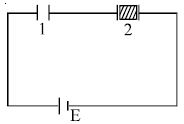
Two identical capacitors $1$ and $2$ are connected in series to a battery as shown in figure. Capacitor $2$ contains a dielectric slab of dielectric constant k as shown. $Q_1$ and $Q_2$ are the charges stored in the capacitors. Now the dielectric slab is removed and the corresponding charges are $Q’_1$ and $Q’_2$. Then 
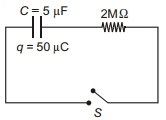
The following circuit consist of a $5 \,\mu F$ capacitor, having charge $50 \,\mu C$ as shown. The switch is closed at $t=0$. The value of current in $2 \,M \Omega$ resistor at $t=0$ is ........... $\mu A$