Question
For a first order reaction, show that time required for 99% completion is twice the time required for the completion of 90% of reaction.

Answer

For a first order reaction, the time required for 99% completion is
$\text{t}_1=\frac{2.303}{\text{k}}\text{log}\frac{100}{100-99}$
$=\frac{2.303}{\text{k}}\text{log}{100}$
$=2\times\frac{2.303}{\text{k}}$
For a first order reaction, the time required for 90% completion is
$\text{t}_2=\frac{2.303}{\text{k}}\text{log}\frac{100}{100-99}$
$=\frac{2.303}{\text{k}}\text{log}{10}$
$=\frac{2.303}{\text{k}}$
Therefore, t1 = 2t2
Hence, the time required for 99% completion of a first order reaction is twice the time required for the completion of 90% of the reaction.

Need a full question paper?

Generate a complete, print-ready paper with questions like this in minutes — across 16+ boards, with answer keys.

Start Generating Free

Similar questions

A solution prepared by dissolving 8.95mg of a gene fragment in 35.0mL. of water has an osmotic pressure of 0.335 torr at 25°C. Assuming that the gene fragment is a non-electrolyte, calculate its molar mass.
  1. What type of isomerism is shown by the complex [Co(NH3)6] [Cr(CN)6]?
  2. Why a solution of [Ni(H2O)6]2+ is green while a solution of [Ni(CN)4]2– is colourless?(At. no. of Ni = 28)
  3. Write the IUPAC name of the following complex: [Co(NH3)5(CO3)]Cl.
Write chemical equations for the following reactions:
  1. Propanone is treated with dilute Ba(OH)2.
  2. Acetophenone is treated with Zn(Hg)/ Conc. HCl
  3. Benzoyl chloride is hydrogenated in presence of Pd/ BaSO4.
A first order reaction is 50% completed in 40 minutes at 300K and in 20 minutes at 320K. Calculate the activation energy of the reaction.
$\big(\text{Given}:\log2=0.3010,\log4=0.6021,\text{R}=8.314\ \text{JK}^{-1}\text{mol}^{-1}\big)$
A graph between ln k and $\frac{1}{\text{t}}$ for a reaction is given. Here k is rate constant and T is temperature in Kelvin.

If OA = a and OB = b, answer the following:
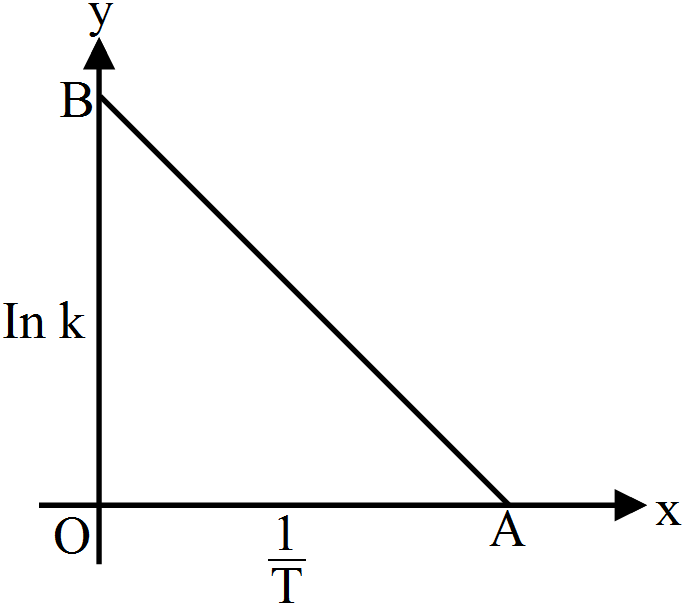
  1. What is the activation energy (Ea) of the reaction?
  2. What is the frequency factor (A) for the reaction?

Calculate the emf of the following cell at 25oC:
Ag(s)|Ag+(10-3M)||Cu2+(10-1M)|Cu(S).
Given Eocell=+0.46 V and log 10n=n.
Two elements A and B form compounds having formula AB2 and AB4. When dissolved in 20 g of benzene (C6H6), 1 g of AB2 lowers the freezing point by 2.3 K whereas 1.0 g of AB4 lowers it by 1.3 K. The molar depression constant for benzene is 5.1 K kg mol–1. Calculate atomic masses of A and B.
Match the items of column I with items of column II.
 
Column I
 
Column II
(i)
Methanol
(a)
Conversion of phenol to o-hydroxysalicylic acid
(ii)
Kolbe’s reaction
(b)
Ethyl alcohol
(iii)
Williamson’s synthesis
(c)
Conversion of phenol to salicylaldehyde
(iv)
Conversion of 2° alcohol to ketone
(d)
Wood spirit
(v)
Reimer-Tiemann reaction
(e)
Heated copper at 573K
(vi)
Fermentation
(f)
Reaction of alkyl halide with sodium alkoxide
What is carbonyl group? Give information about the functional groups containing carbonyl group with their structures.