Question
For a gas $\gamma = 7/5.$ The gas may probably be

Answer

for diatomic gas $\gamma  = 7/5$

Need a full question paper?

Generate a complete, print-ready paper with questions like this in minutes — across 16+ boards, with answer keys.
Start Generating Free

Similar questions

if Energy is given by $U = \frac{{A\sqrt x }}{{{x^2} + B}},\,$, then dimensions of $AB$ is
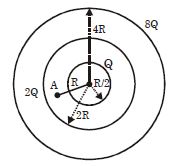
Three charged concentric nonconducting shells are given as shown in figure. Find the potential at point $A$
A liquid cools down from ${70^o}C$ to ${60^o}C$ in $5$ minutes. The time taken to cool it from ${60^o}C$ to ${50^o}C$ will be
The dimension of the magnetic field intensity $B$ is
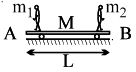
Two persons of mass $m_1$ and $m_2$ are standing at the two ends $A$ and $B $ respectively, of $a$ trolley of mass $M$ as shown. When only the person standing at $B$ jumps from the trolley towards right while the person at $A$ keeps standing, then
Two bodies $A$ and $B$ of same mass undergo completely inelastic one dimensional collision. The body $A$ moves with velocity $v_1$ while body $B$ is at rest before collision. The velocity of the system after collision is $v_2$. The ratio $v_1: v_2$ is
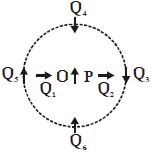
A small magnetised needle $P$ placed at point $O$ and the arrow shows the direction of its magnetic moment. The other arrow show different position (and orientation) of another identical magnets $(Q)$. In which configuration system is not in equilibrium
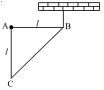
$A$ right triangular plate $ABC$ of mass $m$ is free to rotate in the vertical plane about a fixed horizontal axis through $A$. It is supported by a string such that the side $AB$ is horizontal. The reaction at the support $A$ is:
Which of the following statements is wrong
Given below are two statements: one is labelled as Assertion $A$ and the other is labelled as Reason $R$.

Assertion $A$: The potential ( $V$ ) at any axial point, at $2 \mathrm{~m}$ distance ( $r$ ) from the centre of the dipole of dipole moment vector $\vec{P}$ of magnitude, $4 \times 10^{-6} \mathrm{C} \mathrm{m}$, is $\pm 9 \times 10^3 \mathrm{~V}$.

(Take $\frac{1}{4 \pi \in_0}=9 \times 10^9 \mathrm{Sl}$ units)

Reason $R$: $V= \pm \frac{2 P}{4 \pi \in_0 r^2}$, where $r$ is the distance of any axial point, situated at $2 \mathrm{~m}$ from the centre of the dipole.

In the light of the above statements, choose the correct answer from the options given below: