A liquid cools down from ${70^o}C$ to ${60^o}C$ in $5$ minutes. The time taken to cool it from ${60^o}C$ to ${50^o}C$ will be
Easy


Download our appand get started for free
Experience the future of education. Simply download our apps or reach out to us for more information. Let's shape the future of learning together!No signup needed.*
Similar Questions
- 1Parallel rays of light of intensity $I =912 \ Wm ^{-2}$ are incident on a spherical balck body kept in surroundings of temperature $300 \ K$. Take Stefan-Boltzmann constant $\sigma=5.7 \times 10^{-8} Wm ^{-2} K ^{-4}$ and assume that the energy exchange with the surroundings is only through radiation. Th final steady state temperature of the black body is close to:View Solution
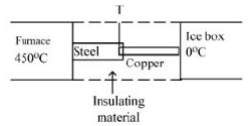
- 2If $K_{1}$ and $K_{2}$ are the thermal conductivities $L_{1}$ and $L _{2}$ are the lengths and $A _{1}$ and $A _{2}$ are the cross sectional areas of steel and copper rods respectively such that $\frac{K_{2}}{K_{1}}=9, \frac{A_{1}}{A_{2}}=2, \frac{L_{1}}{L_{2}}=2$.View Solution
Then, for the arrangement as shown in the figure. The value of temperature $T$ of the steel - copper junction in the steady state will be ........... $^{\circ} C$
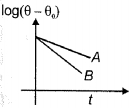
- 3Two bodies $A$ and $B$ of equal masses, area and emissivity cooling under Newton's law of cooling from same temperature are represented by the graph. If $\theta$ is the instantaneous temperature of the body and $\theta_0$ is the temperature of surroundings, then relationship between their specific heats is ..........View Solution
- 4The energy emitted per second by a black body at $27^o\ C$ is $10\ J$. If the temperature of the black body is increased to $327^o\ C$ , the energy emitted per second will be ......... $J$View Solution
- 5View SolutionUnder steady state, the temperature of a body
- 6A metallic sphere cools from $50^{\circ} C$ to $40^{\circ} C$ in $300 \,s.$ If atmospheric temperature around is $20^{\circ} C ,$ then the sphere's temperature after the next $5$ minutes will be close to$.....C$View Solution
- 7The outer faces of a rectangular slab made of equal thickness of iron and brass are maintained at $100^{\circ} C$ and $0^{\circ} C$ respectively. The temperature at the interface is ........... $^{\circ} C$ (Thermal conductivity of iron and brass are $0.2$ and $0.3$ respectively.)View Solution
- 8A black coloured solid sphere of radius $R$ and mass $M$ is inside a cavity with vacuum inside. The walls of the cavity are maintained at temperature $T_0$. The initial temperature of the sphere is $3T_0$. If the specific heat of the material of the sphere varies as $\alpha T^3$ per unit mass with the temperature $T$ of the sphere, where $\alpha $ is a constant, then the time taken for the sphere to cool down to temperature $2T_0$ will be ( $\sigma $ is Stefan Boltzmann constant)View Solution
- 9Two spheres of different materials one with double the radius and one-fourth wall thickness of the other, are filled with ice. If the time taken for complete melting ice in the large radius one is $25$ minutes and that for smaller one is $16$ minutes, the ratio of thermal conductivities of the materials of larger sphere to the smaller sphere isView Solution
- 10Two spheres of the same material have radii $1\; m$ and $4\; m$ and temperatures $4000 \;K$ and $2000 \;K$ respectively. The ratio of the energy radiated per second by the first sphere to that by the second isView Solution