MCQ
For a gas, $\frac{\text{R}}{\text{C}_{\text{V}}}=0.67$ The gas is made up of molecules, which are:
  • Monoatomic.
  • B
    Diatomic.
  • C
    Triatomic.
  • D
    Polyatomic.

Answer

Correct option: A.
Monoatomic.
$\frac{\text{R}}{\text{C}_{\text{V}}}=0.67=\frac{2}{3}$
$\text{C}_{\text{V}}=\frac{3}{2}\text{R}$

Need a full question paper?

Generate a complete, print-ready paper with questions like this in minutes — across 16+ boards, with answer keys.
Start Generating Free

Similar questions

What average horsepower is developed by an  $80 \;kg $ man while climbing in $10\; s$  a flight of stairs that rises $6 m$  vertically ..............$HP$
If $r$ denotes the distance between the sun and the earth, then the angular momentum of the earth around the sun is proportional to
$\Delta U + \Delta W = 0$ is valid for
The loss in weight of a solid when immersed in a liquid at $0^o C$ is $W_0$ and at $t^o C$ is $W$. If cubical coefficient of expansion of the solid and the liquid by $\gamma_s$ and $\gamma_l$ respectively, then $W$ is equal to :
There is some liquid in a closed bottle. The amount of liquid is continuously decreasing. The vapour in the remaining part:
A projectile is thrown in the upward direction making an angle of $60^o $ with the horizontal direction with a velocity of $147\ ms^{-1}$ . Then the time after which its inclination with the horizontal is $45^o $ , is    ......... $\sec$
An ideal monoatomic gas with pressure $P$, volume $V$ and temperature $T$ is expanded isothermally to a volume $2\, V$ and a final pressure $P_i$. If the same gas is expanded adiabatically to a volume $2\,V$, the final pressure is $P_a$ . The ratio $\frac{{{P_a}}}{{{P_i}}}$ is
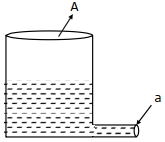
A light cylindrical vessel is kept on a horizontal surface. Area of base is A. A hole of crosssectional area $'a'$ is made just at its bottom side. The minimum coefficient of friction necessary to prevent sliding the vessel due to the impact force of the emerging liquid is $(a\,<\,<\,A)$
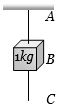
A mass of $1 kg$ is suspended by a string $A$. Another string $C$ is connected to its lower end (see figure). If a sudden jerk is given to $C$, then
A pendulum is hung from the roof of a sufficiently high building and is moving freely to and fro like a simple harmonic oscillator. The acceleration of the bob of the pendulum is $20\; m/s^2$ at a distance of $5\; m$ from the mean position. The time period of oscillation is