MCQ
For a particle executing $\text{SHM}$ along $x-$axis force is given by:
  • $-kx$
  • B
    $A \cos kx$
  • C
    $A\ exp (-kx)$
  • D
    $A kx$

Answer

Correct option: A.
$-kx$
$F = -kx$

Need a full question paper?

Generate a complete, print-ready paper with questions like this in minutes — across 16+ boards, with answer keys.
Start Generating Free

Similar questions

A ball impinges directly on a similar ball at rest. If $1/4^{th}$ of the kinetic energy is lost by the impact, the value of coefficient of restitution is
An open cubical tank was initially fully filled with water. When the tank was accelerated on a horizontal plane along one of its side it was found that one third of volume of water spilled out. The acceleration was
If $A _x$ and $A _y$ are components of a vector then the magnitude of that vector will be :
A loaded spring gun of mass $M$ fires a 'shot' of mass $m$ with a velocity at an angle of elevation $\theta.$ The gun is initially at rest on a horizontal frictionless surface. After firing, the centre of mass of the gun$-$shot system.
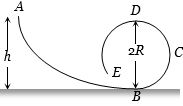
A frictionless track $ABCDE$ ends in a circular loop of radius $R$. A body slides down the track from point $A$ which is at a height $h = 5\, cm$. Maximum value of $R$ for the body to successfully complete the loop is ........... $\mathrm{cm}$
A man is swinging on a swing made of $2$ ropes of equal length $L$ and in direction perpendicular to the plane of paper. The time period of the small oscillations about the mean position is
One end of a thin uniform rod of length $L$ and mass $M_1$is riveted to the centre of a uniform circular disc of radius $r$ and mass $M_2$ so that both are coplanar. The centre of mass of the combination from the centre of the disc is $($assume that the point of attachment is at the origin$).$
Two bodies begin a free fall from the same height at a time interval of $N s$. If vertical separation between the two bodies is $1$ after $n\, second$ from the start of the first body, then $n$ is equal to
For a body executing $S.H.M. :$

$(a)$ Potential energy is always equal to its $K.E.$

$(b)$ Average potential and kinetic energy over any given time interval are always equal.

$(c)$ Sum of the kinetic and potential energy at any point of time is constant.

$(d)$ Average $K.E.$ in one time period is equal to average potential energy in one time period.

Choose the most appropriate option from the options given below:

Two identical mass $M$ moving with velocity $\mu_1$ and $\mu_2$ collide perfectly inelastically. The loss in energy is