MCQ
For a body executing $S.H.M. :$

$(a)$ Potential energy is always equal to its $K.E.$

$(b)$ Average potential and kinetic energy over any given time interval are always equal.

$(c)$ Sum of the kinetic and potential energy at any point of time is constant.

$(d)$ Average $K.E.$ in one time period is equal to average potential energy in one time period.

Choose the most appropriate option from the options given below:

  • $(c)$ and $(d)$
  • B
    only $(c)$
  • C
    $(b)$ and $(c)$
  • D
    only $(b)$

Answer

Correct option: A.
$(c)$ and $(d)$
a
In $S.H.M.$ total mechanical energy remains constant and also $<{K} . {E} .>=<{P} . {E}>=\frac{1}{4} {KA}^{2}$

(for $1$ time period)

Need a full question paper?

Generate a complete, print-ready paper with questions like this in minutes — across 16+ boards, with answer keys.

Start Generating Free

Similar questions

The value of R in SI unit will be:
Assertion $(A):$ An astronaut in an orbiting space station above the earth experience weightlessness.
Reason $(R):$ An object moving around the earth under the influence of earth's gravitational force is in a state of 'free fall'.
A $100 \,g$ of iron nail is hit by a $1.5\, kg$ hammer striking at a velocity of $60\, ms ^{-1}$. $............^{\circ}C$ will be the rise in the temperature of the nail if one fourth of energy of the hammer goes into heating the nail .

[Specific heat capacity of iron  $=0.42\, Jg ^{-1}{ }\,^{\circ}C ^{-1}$ ]

Two springs $A$ and $B$ having spring constant $K_{A}$ and $K_{B}\left(K_{A}=2 K_{B}\right)$ are stretched by applying force of equal magnitude. If energy stored in spring $A$ is $E_{A}$ then energy stored in $B$ will be
We are able to squeeze snow and make balls out of it because of
Which of the following statements is not true ? In the case of a simple pendulum for small amplitudes the period of oscillation is
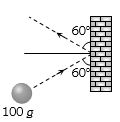
A mass of $100\,g$ strikes the wall with speed $5\,m/s$ at an angle as shown in figure and it rebounds with the same speed. If the contact time is $2 \times {10^{ - 3}}\,\sec $, what is the force applied on the mass by the wall
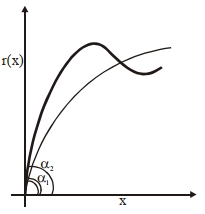
A projectile is launched from the origin in the $xy$ plane ( $x$ is the horizontal and $y$ is the vertically up direction) making an angle $\alpha$ from the $x$-axis. If its distance. $r =\sqrt{ x ^2+ y ^2}$ from the origin is plotted against $x$, the resulting curves show different behaviours for launch angles $\alpha_1$ and $\alpha_2$ as shown in the figure below. For $\alpha_1, r ( x )$ keeps increasing with $x$ while for $\alpha_2$, $r(x)$ increases and reaches a maximum, then decreases and goes through a minimum before increasing again. The switch between these two cases takes place at an angle $\alpha_c\left(\alpha_1 < \alpha_c < \alpha_2\right)$. The value of $\alpha_c$ is [ignore where $v_0$ is the initial speed of the projectile and $g$ is the acceleration due to gravity]
An ice block is melting at a constant rate $\left| {\,\frac{{dm}}{{dt}}\,} \right|= \mu$ . Its initial mass is $m_0$ and it is moving with velocity on a frictionless horizontal surface. The distance travelled by it till it melts completely is :
The width of river is $1\; km$. The velocity of boat is $5\; km/hr$. The boat covered the width of river with shortest will possible path in $15 \;min$. Then the velocity of river stream is