MCQ
For a particle in a non-uniform accelerated circular motion
  • A
    Velocity is radial and acceleration is transverse only
  • B
    Velocity is transverse and acceleration is radial only
  • C
    Velocity is radial and acceleration has both radial and transverse components
  • Velocity is transverse and acceleration has both radial and transverse components
Answer

Correct option: D.
Velocity is transverse and acceleration has both radial and transverse components
d
(d)In non-uniform circular motion particle possess both centripetal as well as tangential acceleration.

Need a full question paper?

Generate a complete, print-ready paper with questions like this in minutes — across 16+ boards, with answer keys.

Start Generating Free

Similar questions

A soap bubble, blown by a mechanical pump at the mouth of a tube, increases in volume, with time, at a constant rate. The graph that correctly depicts the time dependence of pressure inside the bubble is given by
The mean free path of molecules ofa gas, (radius $r$) is inversely proportional to
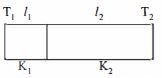
One end of a thermally insulated rod is kept at a temperature $T_1$ and the other at $T_2$ . The rod is composed of two sections of length $l_1$ and $l_2$ and thermal conductivities $K_1$ and $K_2$ respectively. The temperature at the interface of the two section is
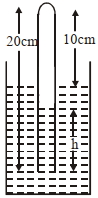
A $20 \,cm$ long tube is closed at one end. It is held vertically, and its open end is dipped in water until only half of it is outside the water surface. Consequently, water rises in it by height $h$ as shown in the figure. The value of $h$ is closest to .............. $\,m / s$ (assume that the temperature remains constant, $P _{\text {armosphere }}=10^5 \,N / m ^2$, density. of water $=10^3 \,kg / m ^3$, and acceleration due to gravity $g =10 \,m / s ^2$ )
Two charge $ + \,q$ and $ - \,q$ are situated at a certain distance. At the point exactly midway between them
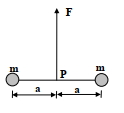
Two particle of mass $m$ each are tied at the ends of a light string of length $2 \mathrm{a}$. The whole system is kept on a frictionless horizontal surface with the string held tight so that each mass is at a distance $'a'$ from the center $\mathrm{P}$ (as shown in the figure). Now, the mid-point of the string is pulled vertically upwards with a small but constant force $F$. As a result, the particles move towards each other on the surface. The magnitude of acceleration, when the separation between them becomes $2 \mathrm{x}$ is
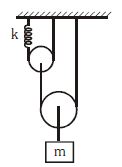
What is the period of small oscillations of the block of mass $m$ if the springs are ideal and pulleys are massless ?
The value of $PV/T$ for one mole of an ideal gas is nearly equal to ......... $J\, mol^{-1}K^{-1}$
A projectile is moving at $20\,m/sec$ at its highest point where it breaks into two equal parts due to an internal explosion. One part moves vertically up at $30\,m/sec$ . Then the other part will move at ............. $\mathrm{m}/ \mathrm{s}$
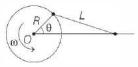
One end of a rod of length $L$ is fixed to a point on the circumference of a wheel of radius $R$. The other end is sliding freely along a straight channel passing through the centre of the wheel as shown in the figure below. The wheel is rotating with a constant angular velocity $\omega$ about $O$. Taking $T=\frac{2 \pi}{\omega}$, the motion of the rod is