The value of $PV/T$ for one mole of an ideal gas is nearly equal to ......... $J\, mol^{-1}K^{-1}$
Medium


Download our appand get started for free
Experience the future of education. Simply download our apps or reach out to us for more information. Let's shape the future of learning together!No signup needed.*
Similar Questions
- 1When water is heated from $0$ to $4\,^oC$View Solution
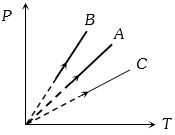
- 2Pressure versus temperature graph of an ideal gas at constant volume $V$ of an ideal gas is shown by the straight line $A$. Now mass of the gas is doubled and the volume is halved, then the corresponding pressure versus temperature graph will be shown by the lineView Solution
- 3The average kinetic energy of a gas at $-23°C$ and $75\, cm$ pressure is $5 \times {10^{ - 14}}\,erg$ for ${H_2}$. The mean kinetic energy of the ${O_2}$ at $227°C$ and $150\, cm$ pressure will beView Solution
- 4At $27°C$ temperature, the kinetic energy of an ideal gas is ${E_1}$. If the temperature is increased to $327°C,$ then kinetic energy would beView Solution
- 5A gas at absolute temperature $300\,K$ has pressure $= 4 \times 10^{-10}\,N /m^2$ . Boltzmann constant, $k = 1.38 \times 10^{-23}\,J / K$ . The number of molecules per $cm^3$ is of the order ofView Solution
- 6Two gases-argon (atomic radius $0.07 \;\mathrm{nm}$,atomic weight $40$ ) and xenon (atomic radius $0.1\; \mathrm{nm},$ atomic weight $140$ ) have the same number density and are at the same temperature. The raito of their respective mean free times is closest toView Solution
- 7View SolutionThe degrees of freedom of a stationary rigid body about its axis will be
- 8For a certain process, pressure of diatomic gas varies according to the relation $P = aV^2$, where $a$ is constant. What is the molar heat capacity of the gas for this process?View Solution
- 9$N\,moles$ of a diatomic gas in a cylinder are at a temperature $T$. Heat is supplied to the cylinder such that the temperature remains constant but $n\,moles$ of the diatomic gas get converted into monoatomic gas. What is the change in the total kinetic energy of the gas ?View Solution
- 10One grams of $H_2$ at $27\,^oC$ is mixed with $16\, g$ of $O_2$ at $37\,^oC$. The temperature of the mixture is about ....... $^oC$View Solution