MCQ
For a particle in a non-uniform accelerated circular motion
  • A
    Velocity is radial and acceleration is transverse only
  • B
    Velocity is transverse and acceleration is radial only
  • C
    Velocity is radial and acceleration has both radial and transverse components
  • Velocity is transverse and acceleration has both radial and transverse components
Answer

Correct option: D.
Velocity is transverse and acceleration has both radial and transverse components
d
(d)In non-uniform circular motion particle possess both centripetal as well as tangential acceleration.

Need a full question paper?

Generate a complete, print-ready paper with questions like this in minutes — across 16+ boards, with answer keys.

Start Generating Free

Similar questions

A capacitor of capacitance $500\mu\text{F}$ is connected to a battery through a $10\text{k}\Omega$ resistor. The charge stored in the capacitor in the first 5s is larger than the charge stored in the next:
  1. 5s
  2. 50s
  3. 500s
  4. 500
The velocity of a particle in simple harmonic motion at displacement $y$ from mean position is
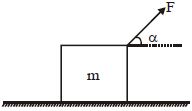
At the instant $t = 0$ a force $F = kt$ ( $k$ is a constant) acts on a small body of mass $m$ resting on a smooth horizontal surface. The time, when body leaves the surface is
Two satellites of equal mass are revolving around earth in elliptical orbits of different semi-major axis. If their angular momenta about earth centre are in the ratio $3: 4$ then ratio of their areal velocity is ........
The transverse displacement in a streched string is given by
$y = 0.06 \sin \, \left( {\frac{{2\pi }}{3}x} \right)\cos \,(120\pi t)$

where $x$ and $y$ are in $m$ and $t$ is in $s$. The length of the string is $1.5\, m$ and  its mass is $3.0 \times 10^{-2} \,kg$, then tension in string is ..... $N$

The thermodynamic process, in which internal energy of the system remains constant is ...........
A solid sphere is thrown up a rough incline. The sphere rolls up without slipping and eventually comes down rolling without slipping. The direction of rolling friction in upward and downward motion respectively is ............
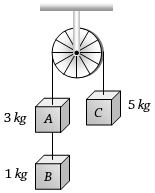
Three weight $A, B$ and $C$ are connected by string as shown in the figure. The system moves over a frictionless pulley. The tension in the string connecting $A$ and $B$ is (where $g$ is acceleration due to gravity)
A body travels $102.5 \mathrm{~m}$ in $\mathrm{n}^{\text {th }}$ second and $115.0 \mathrm{~m}$ in $(n+2)^{\text {th }}$ second. The acceleration is :
A student plotted the following four graphs representing the variation of velocity of sound in a gas with the pressure $P$. Which one is correct