MCQ
For a particle in circular motion the centripetal acceleration is
  • A
    Less than its tangential acceleration
  • B
    Equal to its tangential acceleration
  • C
    More than its tangential acceleration
  • May be more or less than its tangential acceleration

Answer

Correct option: D.
May be more or less than its tangential acceleration
d
(d)There is no relation between centripetal and tangential acceleration. Centripetal acceleration is must for circular motion but tangential acceleration may be zero.

Need a full question paper?

Generate a complete, print-ready paper with questions like this in minutes — across 16+ boards, with answer keys.
Start Generating Free

Similar questions

The angular speed of a fly wheel moving with uniform angular acceleration changes from $1200\,rpm$ to $3120\,rpm$ in $16$ seconds. The angular acceleration in $rad/s^{2}$ is :
A mass $m$ moving horizontally (along the $x-$ axis) with velocity $v$ collides and sticks to a mass of $3\,m$ moving vertically upward (along the $y-$axis) with velocity $2v.$ The final velocity of the combination is
Two non-reactive monoatomic ideal gases have their atomic masses in the ratio $2: 3$. The ratio of their partial pressures, when enclosed in a vessel kept at a constant temperature, is $4: 3$. The ratio of their densities is:
$Kilowatt - hour$ is a unit of
The correct statement from the following is
Two cars are moving in the same direction with the same speed $30 \,km/hr$. They are separated by a distance of $5\, km$, the speed of a car moving in the opposite direction if it meets these two cars at an interval of $4$ minutes, will be.......$km/hr$
In a physical balance working on the principle of moments, when $5\, mg$ weight is placed on the left pan, the beam becomes horizontal. Both the empty pans of the balance are of equal mass. Which of the following statements is correct?
A particle is moving in a circle of radius $r$ under the action of a force $F\, = \alpha r^2$ which is directed towards centre of the circle. Total mechanical energy (kinetic energy + potential energy) of the particle is (take potential energy $= 0$ for $r\, = 0$)
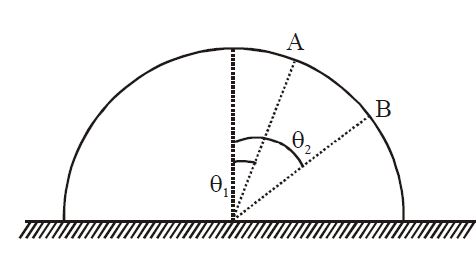
A small block slides down from rest at point $A$ on the surface of a smooth cylinder, as shown. At point $B$, the block falls off (leaves) the cylinder. The equation relating the angles $\theta_1$ and $\theta_2$ is given by
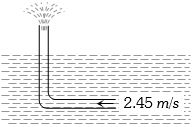
An $ L-$ shaped tube with a small orifice is held in a water stream as shown in fig. The upper end of the tube is $ 10.6 cm$  above the surface of water. ....... $cm$ will be the height of the jet of water coming from the orifice ? Velocity of water stream is $2.45 m/s$