MCQ
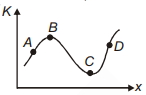
For a particle moving under the action of a variable force, kinetic energy-position graph is given, then
  • A
    At $A$ particle is decelerating
  • B
    At $B$ particle is accelerating
  • C
    At $C$ particle has maximum velocity
  • At $D$ particle has maximum acceleration
Answer

Correct option: D.
At $D$ particle has maximum acceleration
d
(d)

$F . d x=d K$

$\frac{d K}{d x}=F$

$\Rightarrow$ Slope of $K-x$ curve gives force

So slope is max at $D$, hence acceleration is maximum at $D$

Need a full question paper?

Generate a complete, print-ready paper with questions like this in minutes — across 16+ boards, with answer keys.

Start Generating Free

Similar questions

The ratio of escape velocity of a planet to the escape velocity of earth will be:Given : Mass of the planet is $16$ times mass of earth and radius of the planet is $4$ times the radius of earth.
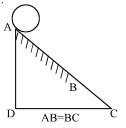
Portion $AB$ of the wedge shown in figure is rough and $BC$ is smooth. $A$ solid cylinder rolls without slipping from $A$ to $B$. The ratio of translational kinetic energy to rotational kinetic energy, when the cylinder reaches point $C$ is :
A body of mass $2 \,kg$ has an initial velocity of $3\, meters$ per second along $OE$ and it is subjected to a force of $4 \,N$ in a direction perpendicular to $OE$. The distance of the body from $O$ after $4$ seconds will be  ........... $m$
Initial pressure and volume of a gas are $ P$ and $V$ respectively. First it is expanded isothermally to volume $4V$ and then compressed adiabatically to volume $ V$. The final pressure of gas will be
In a projectile motion the velocity:
  1. Is always perpendicular to the acceleration.
  2. Is never perpendicular to the acceleration.
  3. Is perpendicular to the acceleration for one instant only.
  4. Is perpendicular to the acceleration for two instants.
The equation of a projectile is $y=\sqrt{3} x-\frac{ x^2}{2}$, the velocity of projection is
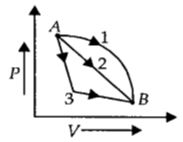
An ideal gas goes from state $A$ to state $B$ via three different processes as indicated in the $P-V$ diagram. If $Q_1, Q_2, Q_3$ indicate the heat absorbed by the gas along the three processes and $\Delta U_1, \Delta U_2, \Delta U_3$ 
indicate the change in internal energy along the three processes respectively, then 
A closed organ pipe has a fundamental frequency of $1.5\, kHz$. The number of overtones that can be distinctly heard by a person with this organ pipe will be : (Assume that the highest frequency a person can hear is $20,000\, Hz$)
A stationary particle explodes into two particles of masses $x$ and $y$, which move in opposite directions with velocity $v_1$ and $v_2$. The ratio of their kinetic energies $\left(E_1: E_2\right)$ is
A ball of mass m falls vertically to the ground from a height$ h_1$ and rebound to a height ${h_2}$. The change in momentum of the ball on striking the ground is