MCQ
For a particle performing linear S.H.M., its average speed over one oscillation is ( $a=$ amplitude of S.H.M., $n=$ frequency of oscillation)
  • A
    $2 a n$
  • $4 a n$
  • C
    $6 a n$
  • D
    $8 a n$

Answer

Correct option: B.
$4 a n$
(b) : Distance travelled in one oscillation is $4 a$ and time period is $T$.
$
\text { Velocity }=\frac{4 a}{T}=4 a n \quad\left[\because n=\frac{1}{T}\right]
$

Need a full question paper?

Generate a complete, print-ready paper with questions like this in minutes — across 16+ boards, with answer keys.
Start Generating Free

Similar questions

Two simple harmonic waves of the same amplitude and frequency, but $90^{\circ}$ out of phase, pass through the same region in a medium. The resultant wave has
A galvanometer with its coil resistance $25 \Omega$ requires a current of $1 mA$ for its full deflection. In order to construct an ammeter to read up to a current of $2 A$, the approximate value of the shunt resistance should be
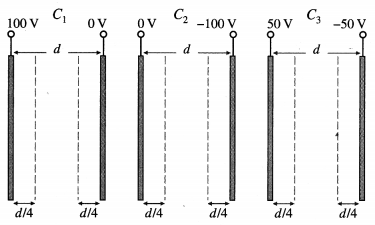
The figure shows three capacitors $C_1 C_2$ and $C_3$. The dashed lines are equipotential surfaces within each capacitor. In which of the capacitors is the po. between the two equipotentials $\Delta V =50 V$ ?

Image

A set of tuning forks is arranged in ascending order of frequencies each tuning fork gives 8 beats/s with the preceding one. If the frequency of the first tuning fork is 120 Hz and the last fork is 200 Hz, then the number of tuning forks arranged will be, ______ 
A $10 m$ long potentiometer wire has a resistance of $20 \Omega$. If it is connected in series with a resistance of $55 \Omega$ and a cell of emf $4 V$ and internal resistance $5 \Omega$, the potential gradient along the wire is
The energy stored in a soap bubble of diameter $6$ cm and $T = 0.04 N/m$ is nearly
Interference fringes are produced on a screen by using two light sources of intensities $I$ and $9 I$. The phase difference between the beams is $\frac{\pi}{2}$ at point $P$ and $\pi$ at point $Q$ on the screen. The difference between the resultant intensities at point $P$ and $Q$ is
A thermodynamic process of uncontrolled change satisfying the equation $Q=W=0$, is $[ Q =$ heat supplied, $W=$ work done $]$
The coefficient of performance of a Carnot refrigerator working between $T_H$ and $T_C$ is $K$ and the efficiency of a Carnot engine working between the same $T_H$ and $T_c$ is $\eta$. Then
During refrigeration cycle, heat is rejected by the refrigerant in the :