For a particle showing motion under the force $F=-5(x-2)$, the motion is ...........
Easy


Download our appand get started for free
Experience the future of education. Simply download our apps or reach out to us for more information. Let's shape the future of learning together!No signup needed.*
Similar Questions
- 1The amplitude of a damped oscillator decreases to $0.9$ times its original magnitude in $5\ s$. In another $10\ s$ it will decrease to $\alpha $ times its original magnitude, where $\alpha $ equalsView Solution
- 2The displacement of a particle executing $SHM$ is given by $y=0.25 \sin 200 t$ $cm$. The maximum speed of the particle is $.........cm s^{-1}$View Solution
- 3An object of mass $0.2\ kg$ executes simple harmonic along $X-$ axis with frequency of $\frac{{25}}{\pi } Hz$ . At the position $x$ = $0.04\ m$ , the object has kinetic energy of $0.5\ J$ and potential energy of $0.4\ J$ amplitude of oscillation in meter is equal toView Solution
- 4The amplitude of a damped oscillator becomes one third in $2\, sec$. If its amplitude after $6\, sec$ is $1/n$ times the original amplitude then the value of $n$ isView Solution
- 5Two masses $m_1$ and $m_2$ are suspended together by a massless spring of constant $K$. When the masses are in equilibrium, $m_1$ is removed without disturbing the system. The amplitude of oscillations isView Solution

- 6A spring mass system executes damped harmonic oscillations given by the equationView Solution
$y = A{e^{ - \frac{{bt}}{{2m}}}}\sin (\omega 't + \phi )$
where the symbols have their usual meanings. If a $2\ kg$ mass $(m)$ is attached to a spring of force constant $(K)$ $1250\ N/m$ , the period of the oscillation is $\left( {\pi /12} \right)s$ . The damping constant $‘b’$ has the value. ..... $kg/s$
- 7The position, velocity and acceleration of a particle executing simple harmonic motion are found to have magnitudes of $4 \mathrm{~m}, 2 \mathrm{~ms}^{-1}$ and $16 \mathrm{~ms}^{-2}$ at a certain instant. The amplitude of the motion is $\sqrt{\mathrm{x}} \mathrm{m}$ where $\mathrm{x}$ is. . . . . . .View Solution
- 8Force constant of a spring is $K$ . If half part is detached then force constant of the remaining spring will beView Solution
- 9View SolutionA chimpanzee swinging on a swing in a sitting position, stands up suddenly, the time period will
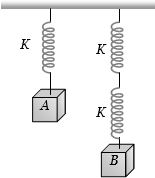
- 10The springs shown are identical. When $A = 4kg$, the elongation of spring is $1\, cm$. If $B = 6\,kg$, the elongation produced by it is ..... $ cm$View Solution