The amplitude of a damped oscillator becomes one third in $2\, sec$. If its amplitude after $6\, sec$ is $1/n$ times the original amplitude then the value of $n$ is
Medium


Download our appand get started for free
Experience the future of education. Simply download our apps or reach out to us for more information. Let's shape the future of learning together!No signup needed.*
Similar Questions
- 1A particle executes $SHM.$ Its velocities are $v_1$and $v_2$ at displacement $x_1$ and $x_2$ from mean position respectively. The frequency of oscillation will beView Solution
- 2Two simple harmonic motions are represented by the equationsView Solution
${x}_{1}=5 \sin \left(2 \pi {t}+\frac{\pi}{4}\right)$ and ${x}_{2}=5 \sqrt{2}(\sin 2 \pi {t}+\cos 2 \pi {t})$
The amplitude of second motion is ....... times the amplitude in first motion.
- 3Function $x$ = $A sin^2 wt + B cos^2 wt + C sin wt \ cos wt$ does not represents $SHM$ for this conditionView Solution
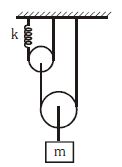
- 4What is the period of small oscillations of the block of mass $m$ if the springs are ideal and pulleys are massless ?View Solution
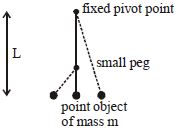
- 5A simple pendulum of length $L$ is constructed from a point object of mass $m$ suspended by a massless string attached to a fixed pivot point. $A$ small peg is placed a distance $2L/3$ directly below the fixed pivot point so that the pendulum would swing as shown in the figure below. The mass is displaced $5$ degrees from the vertical and released. How long does it take to return to its starting position?View Solution
- 6Choose the correct length $( L )$ versus square of time period $\left( T ^2\right)$ graph for a simple pendulum executing simple harmonic motion.View Solution
- 7The displacement of a particle undergoing $SHM$ of time period $T$ is given by $x(t) = x_m\,cos\, (\omega t + \phi )$. The particle is at $x = -x_m$ at time $t = 0$. The particle is at $x = + x_m$ whenView Solution
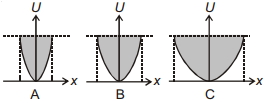
- 8The variations of potential energy $(U)$ with position $x$ for three simple harmonic oscillators $A, B$ and $C$ are shown in figure. The oscillators have same mass. The time period of oscillation is greatest forView Solution
- 9A particle of mass $10$ grams is executing simple harmonic motion with an amplitude of $0.5\, m$ and periodic time of $(\pi /5)$ seconds. The maximum value of the force acting on the particle is ... $N$View Solution
- 10Given below are two statements:View Solution
Statement $I :$ A second's pendulum has a time period of $1$ second.
Statement $II :$ It takes precisely one second to move between the two extreme positions.
In the light of the above statements, choose the correct answer from the options given below: