Question
For a photosensitive surface, threshold wavelength is $\lambda_0.$ Does photoemission occur if the wavelength of radiation is (i) more than $\lambda_0$ and (ii) less than $\lambda_0?$ Justify your answer.

Answer

Energy of a photon $\text{E}=\frac{\text{hc}}{\lambda}$ For emission of photoelectrons energy of a photon $\geq$ work function or wavelength of incident photon $\lambda$ should be less than threshold wavelength $\lambda_0(\text{i.e., }\lambda<\lambda_0).$

Need a full question paper?

Generate a complete, print-ready paper with questions like this in minutes — across 16+ boards, with answer keys.

Start Generating Free

Similar questions

Why do stable nuclei never have more protons than neutrons?
A farsighted person cannot see objects placed closer to 50cm. Find the power of the lens needed to see the objects at 20cm.
A 30.0cm long wire having a mass of 10.0g is fixed at the two ends and is vibrated in its fundamental mode. A 50.0cm long closed organ pipe, placed with its open end near the wire, is set up into resonance in its fundamental mode by the vibrating wire. Find the tension in the wire. Speed of sound in air = 340m/s.
Write and explain Kirchhoff's junction rule.
A ball of superconducting material is dipped in liquid nitrogen and placed near a bar magnet.
i. In which direction will it move?
ii. What will be the direction of its magnetic moment?
About 5% of the power of a 100 W light bulb is converted to visible radiation. What is the average intensity of visible radiation

  1. at a distance of 1m from the bulb?
  2. at a distance of 10 m?

Assume that the radiation is emitted isotropically and neglect reflection.
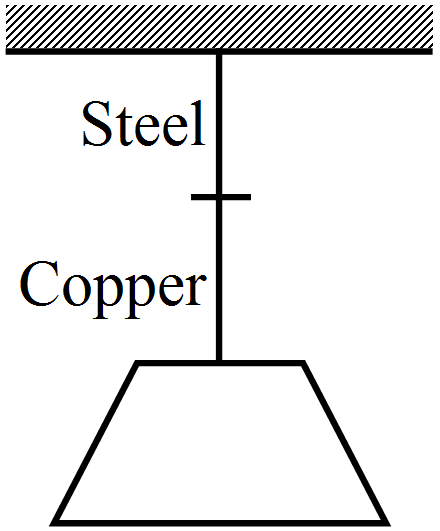
In the upper wire is made of steel and the lower of copper. The wires have equal cross-section. Find the ratio of the longitudinal strains developed in the two wires.

Two bar magnets are placed close to each other with their opposite poles facing each other. In absence of other force the magnets are pulled towards each other and their kinetic energy increases. Does it contradict our earher knowledge that magnetic forces cannot do any work and hence cannot increase kinetic energy of a system?
Two transparent slabs having equal thickness but different refractive indices $\mu_1$ and $\mu_2$ are pasted side by side to form a composite slab. This slab is placed just after the double slit in a Young's experiment so that the light from one slit goes through one material and the light from the other slit goes through the other material. What should be the minimum thickness of the slab so that there is a minimum at the point P0 which is equidistant from the slits?
A plate of thickness t made of a material of refractive index $\mu$ is placed in front of one of the slits in a double slit experiment.
  1. Find the change in the optical path due to introduction of the plate.
  2. What should be the minimum thickness t which will make the intensity at the centre of the fringe pattern zero? Wavelength of the light used is $\lambda$. Neglect any absorption of light in the plate.