Question
For a photosensitive surface, threshold wavelength is $\lambda_0.$ Does photoemission occur if the wavelength of radiation is (i) more than $\lambda_0$ and (ii) less than $\lambda_0?$ Justify your answer.

Answer

Energy of a photon $\text{E}=\frac{\text{hc}}{\lambda}$ For emission of photoelectrons energy of a photon $\geq$ work function or wavelength of incident photon $\lambda$ should be less than threshold wavelength $\lambda_0(\text{i.e., }\lambda<\lambda_0).$

Need a full question paper?

Generate a complete, print-ready paper with questions like this in minutes — across 16+ boards, with answer keys.
Start Generating Free

Similar questions

A closely wound solenoid of 800 turns and area of cross section $2.5 \times 10^{-4} \mathrm{~m}^2$ carries a current of 3.0 A. Explain the sense in which the solenoid acts like a bar magnet. What is its associated magnetic moment?
Explain : "Electric charges are additive in nature."
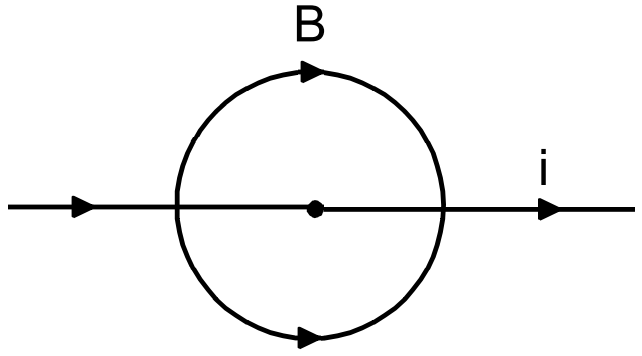
A conducting circular loop of radius a is connected to two Iong, straight wires. The straight wires carry current I as shown in figure. Find the magnetic field B at the centre of the loop.
Mention two important conclusions regarding the relation between electric field and electric potential.
Explain the difference between behaviour of a conductor and a dielectric inside external electric field.
Write the formula for the force per unit length between two parallel current carrying wires. Using it, write the definition of Ampere and Coulomb.
Define the distance of closest approach. An α-particle of kinetic energy 'K' is bombarded on a thin gold foil. The distance of the closest approach is 'r'. What will be the distance of closest approach for an α-particle of double the kinetic energy?
Three charges $-q, Q$ and $-q$ are situated at equal distances in a straight line. If the total potential energy of the system of all three charges is zero, then what will be the value of ratio $Q : q$ ?
A point charge produces an electric field of magnitude $5.0NC^{-1}$ at a distance of 40cm from it. What is the magnitude of the charge?
A metallic rod of 'L' length is rotated with angular frequency of '$\omega$' with one end hinged at the centre and the other end at the circumference of a circular metallic ring of radius L, about an axis passing through the centre and perpendicular to the plane of the ring. A constant and uniform magnetic field B parallel to the axis is present everywhere. Deduce the expression for the emf between the centre and the metallic ring.