MCQ
For a projectile, the ratio of maximum height reached to the square of flight time is ($g = 10 ms^{-2}$)
  • $5:4$
  • B
    $5:2$
  • C
    $5:1$
  • D
    $10:1$

Answer

Correct option: A.
$5:4$
a
(a) $H = \frac{{{u^2}{{\sin }^2}\theta }}{{2g}}$ and $T = \frac{{2u\sin \theta }}{g}$

So $\frac{H}{{{T^2}}} = \frac{{{u^2}{{\sin }^2}\theta /2g}}{{4{u^2}{{\sin }^2}\theta /{g^2}}} = \frac{g}{8} = \frac{5}{4}$

Need a full question paper?

Generate a complete, print-ready paper with questions like this in minutes — across 16+ boards, with answer keys.
Start Generating Free

Similar questions

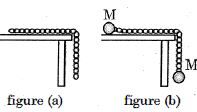
A chain lying on an absolutely smooth table, half of it hanging over the edge of the table as shown in figure $(a)$. The time it takes to slip off the table is affected if two equal weights be attached, one to each end as shown in figure $(b)$ .
$t_a$ : time taken to slip in situation $'a'$
$t_b$ : time taken to slip in situation $'b'$
A gas is compressed isothermally to half its initial volume. The same gas is compressed separately through an adiabatic process until its volume is again reduced to half. Then
What would happen if the Earth did not rotate on its axis?
Displacement between maximum potential energy position and maximum kinetic energy position for a particle executing $S.H.M.$ is
Which pair has the same dimensions
Consider a body of mass $1.0 \mathrm{~kg}$ at rest at the origin at time $\mathrm{t}=0$. A force $\overrightarrow{\mathrm{F}}=(\alpha \mathrm{t} \hat{\mathrm{i}}+\beta \hat{\mathrm{j}})$ is applied on the body, where $\alpha=1.0 \mathrm{Ns}^{-1}$ and $\beta=1.0 \mathrm{~N}$. The torque acting on the body about the origin at time $\mathrm{t}=1.0 \mathrm{~S}$ is $\vec{\tau}$. Which of the following statements is (are) true?

$(A)$ $|\vec{\tau}|=\frac{1}{3} \mathrm{Nm}$

$(B)$ The torque $\vec{\tau}$ is in the direction of the unit vector $+\hat{\mathrm{k}}$

$(C)$ The velocity of the body at $\mathrm{t}=1$ is $\overrightarrow{\mathrm{v}}=\frac{1}{2}(\hat{\mathrm{i}}+2 \hat{\mathrm{j}}) \mathrm{m} \mathrm{s}^{-1}$

$(D)$ The magnitude of displacement of the body at $\mathrm{t}=1 \mathrm{~s}$ is $\frac{1}{6} \mathrm{~m}$
A wave has velocity $u$ in medium $P$ and velocity $2u$ in medium $Q.$ If the wave is incident in medium $P$ at an angle of $30°$ then the angle of refraction will be .... $^o$
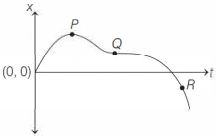
In the following displacement $x$ versus time $t$ graph, at which among the points $P, Q$ and $R$ is the object's speed increasing?
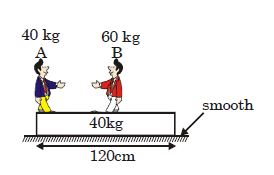
Two men $‘A’$ and $‘B’$ are standing on a plank. $‘B’$ is at the middle of the plank and $‘A’$ is at the left end of the plank. System is initially at rest and masses are as shown in figure. $‘A’$ and $‘B’$ starts moving such that the position of $‘B’$ remains fixed with respect to ground till $‘A’$ meets $‘B’$ . Then the point where $A$ meets $B$ is located at 
Diffusion current in a p-n junction is greater than the drift current in magnitude: