MCQ
For a rigid diatomic molecule, universal gas constant $R=n C_p$ where $C_p$ is the molar specific heat at constant pressure and $n$ is a number. Hence $n$ is equal to
  • A
    0.2257
  • B
    0.4
  • 0.2857
  • D
    0.3557

Answer

Correct option: C.
0.2857
(c) : For a rigid diatomic molecule
$
\begin{aligned}
& \frac{C_P}{C_V}=\frac{7}{5} \\
& C_V=\frac{5}{7} C_P \\
& C_P-C_V=R \\
& C_P-\frac{5}{7} C_P=n C_P
\end{aligned}
$
$\frac{2}{7} C_p=n C_p \Rightarrow n=\frac{2}{7}=0.2857$

Need a full question paper?

Generate a complete, print-ready paper with questions like this in minutes — across 16+ boards, with answer keys.
Start Generating Free

Similar questions

At points of constructive interference with maximum intensity of two coherent monochromatic waves (wavelength $\lambda$, the path difference between them is
In a capillary tube of radius $R$, a straight thin metal wire of radius $r(R>r)$ is inserted symmetrically and one end of the combination is dipped vertically in water such that the lower end of the combination is at same level. The rise of water in the capillary tube is $[T=$ surface tension of water, $\rho=$ density of water, $g=$ gravitational acceleration$]$
If the ratio of the intensities of two waves producing interference is $49: 16$, then the ratio of the resultant maximum intensity to minimum intensity will be
Which of the following is correct?
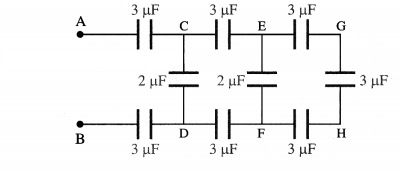
The resultant capacitance between the points $A$ and $B$ in the figure below is:

Image

A particle is performing simple harmonic motion with amplitude A and angular velocity ω. The ratio of maximum velocity to maximum acceleration is ______.
A narrow beam of light in air is incident on glass at an angle of incidence of $58^{\circ}$. If the reflected beam is completely plane polarized, the refractive index of the glass is
In a transistor amplifier, $IC = 5.5 mA , IE = 5.6 mA$. The current amplification factor $\beta$ is ______ 
A uniformly charged semicircular arc of radius $'r\ '$ has linear charge density $' \lambda\ ' $.The electric field at its centre is $($ $\varepsilon_0=$ permittivity of free space$)$
In 20 s, two simple pendulums, $P$ and $Q$, complete 9 and 7 oscillations, respectively, on the Earth. On theMoon, where the acceleration due to gravity is $\frac{1}{6}$ th that on the Earth, their periods are in the ratio