MCQ
The resultant capacitance between the points $A$ and $B$ in the figure below is:
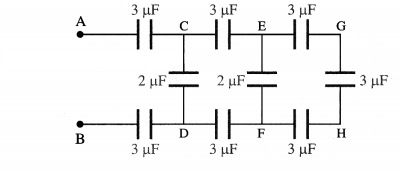
Image

  • $1 \mu F$
  • B
    $1.5 \mu F$
  • C
    $2 \mu F$
  • D
    $3 \mu F$.

Answer

Correct option: A.
$1 \mu F$
$1 \mu F$

Need a full question paper?

Generate a complete, print-ready paper with questions like this in minutes — across 16+ boards, with answer keys.

Start Generating Free

Similar questions

The instrument which can measure terminal potential difference as well as electromotive force (emf) is ______ 
A circular coil carrying current ' $T$ ' has radius ' $R$ ' and magnetic field at the centre is ' $B$ '. At what distance from the centre along the axis of the same coil, the magnetic field will be $\frac{B}{8}$ ?
To convert a moving coil galvanometer into an ammeter we need to connect a ______.
A galvanometer of resistance $20 \Omega$ gives a deflection of 5 divisions when 1 mA current flows through it. The galvanometer scale has 50 divisions. To convert the galvanometer into a voltmeter of range 25 volt, we should connect a resistance of
The adiabatic constant $\gamma$ for argan is
A mass is suspended from a spring having spring constant ' $K$ ' is displaced vertically and released, oscillates with period ' $T$ '. The weight of the mass suspended is ( $g=$ gravitational acceleration)
A seconds pendulum is placed in a space laboratory orbiting round the earth at a height ' $3 R$ ' from the earth's surface. The time period of the pendulum will be ( $R=$ radius of earth)
A seconds pendulum is suspended in an elevator moving with a constant speed in the downward direction. The periodic time (T) of that pendulum is
Consider two SHMs along the same straight line $x_1=A_1 \sin \left(\omega t+\phi_1\right), x_2=A_2 \sin \left(\omega t+\phi_2\right)$, where $A_1$ and $A_2$ are their amplitudes and $\phi_1$ and $\phi_2$ are their initial phase angle. If the two SHMs meet simultaneously and ' $R$ ' is the resultant amplitude, match column I with column II.
Column-IColumn-II
A.The two SHMs are in phase, $A_1=A_2=A$I.$R=A_1+A_2$
B.The two SHMs are in phase, $A_1 \neq A_2$II.$R=0$
C.The two SHMs are $90^{\circ}$ out of phase, $A_1=A_2=A$III.$R=2 A$
D.The two SHMs are $180^{\circ}$out of phase, $A_1=A_2$IV.$R=\sqrt{2} A$
Polychromatic (containing many different frequencies) radiation is used in an experiment on the photoelectric effect. The stopping potential