MCQ
For a single slit of width a, the diffraction pattern minima are located at angles $\theta_m$, where $m$ is a positive, non-zero integer. Which of the following expressions is most correct?
  • $a \sin \theta_m=m \lambda$
  • B
    $a \sin \theta_m=\frac{m \lambda}{2}$
  • C
    $a \sin \theta_m=(2 m+1) \frac{\lambda}{2}$
  • D
    $a \sin \theta_m=(2 m-1) \frac{\lambda}{2}$

Answer

Correct option: A.
$a \sin \theta_m=m \lambda$

Need a full question paper?

Generate a complete, print-ready paper with questions like this in minutes — across 16+ boards, with answer keys.

Start Generating Free

Similar questions

A stretched string tied between two rigid supports vibrates with a frequency double the fundamental frequency. The point midway between the supports is
In Young's double slit experiment, the fringe wid th is $2 mm$. The separation between the $13^{\text {th }}$ bright fringe and the $4^{\text {th }}$ dark fringe from the centre of the screen on same side will be
A disc has mass ' $M$ ' and radius ' $R$ '. How much tangential force should be applied to the rim of the disc so as to rotate with angular velocity ' $\omega$ ' in time ' $t$ '?
The relation between relative permeability and magnetic susceptibility is given by
In the law of tension, the fundamental frequency of the vibrating string is, ______ 
A hollow sphere of mass ' $M$ ' and radius ' $R$ ' is rotating with angular frequency ' $\omega$ '. It suddenly stops rotating and $75 \%$ of kinetic energy is converted to heat. If ' $S$ ' is the specific heat of the material in $J / kg K$ then rise in temperature of the sphere is (M.I. of hollow sphere $=\frac{2}{3} M R^2$ )
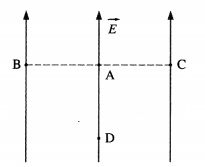
In the diagram, $\vec{E}$ is a uniform electric field. Point $B$ is to the west of point $A$ while point $C$ is to the east and point $D$ is to the south. Which of the following is correct?

Image

The surface tension acts
A sphere and a cube, both of copper have equal volumes and are black. They are allowed to cool at same temperature and in same atmosphere. The ratio of their rate of loss of heat will be