MCQ
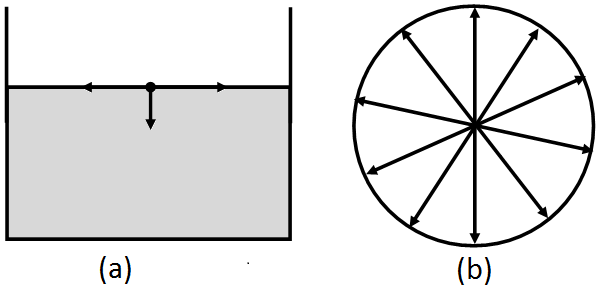
For a surface molecule:
  • A
    The net force on it is zero.
  • B
    There is a net downward force.
  • C
    The potential energy is more than that of a molecule inside.
  • Both $B$ and $D$

Answer

Correct option: D.
Both $B$ and $D$
A molecule viewed from the top to surface of the fluid. Force exerted on a molecule by all nearby molecule are equal and opposite, so net horizontal component of force is zero. as a molecule is viewed horizontally to the surface of fluid a vertically downward force acts on molecule due to which it does not escape from surface.

There is a net attractive force on molecules at surface acting downwards.
So the $P.E$ of molecules at the surface is negative to lower ones but in magnitude $\text{PE(mgh)}$ is more than that of the lower or inside molecules.

Need a full question paper?

Generate a complete, print-ready paper with questions like this in minutes — across 16+ boards, with answer keys.
Start Generating Free

Similar questions

A particle of mass $m$ travelling along $x-$ axis with speed $v_0$ shoots out $1/3^{rd}$ of its mass with a speed $2v_0$ along $y-$ axis. The velocity of remaining piece is
A ball rolls off the top of a stairway with horizontal velocity $\mathrm{u}$. The steps are $0.1 \mathrm{~m}$ high and $0.1 \mathrm{~m}$ wide. The minimum velocity $\mathrm{u}$ with which that ball just hits the step $5$ of the stairway will be $\sqrt{\mathrm{x}} \mathrm{ms}^{-1}$ where $\mathrm{x}=$___________ [use $\mathrm{g}=10 \mathrm{~m} / \mathrm{s}^2$ ].
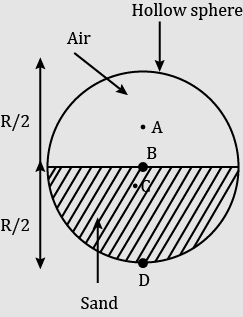
Which of the following points is the likely position of the centre of mass of the system shown in the figure ?
Image
How many times is escape velocity $({V_e})$, of orbital velocity $({V_0})$ for a satellite revolving near earth
The distance of centre of mass from end $A$ of a one dimensional rod $( AB )$ having mass density $\rho=\rho_{0}\left(1-\frac{ x ^{2}}{ L ^{2}}\right)\,kg / m$ and length $L$ (in meter) is $\frac{3 L }{\alpha} m$. The value of $\alpha$ is $\ldots \ldots \ldots . .$ (where $x$ is the distance form end $A$ )
Which of the following material is used to make calorimeter?
The internal energy of $2$ moles of a mono atomic gas is:
A particle of mass $'{m}'$ is moving in time $'t'$ on a trajectory given by

$\overrightarrow{{r}}=10 \alpha {t}^{2}\, \hat{{i}}+5 \beta({t}-5)\, \hat{{j}}$

Where $\alpha$ and $\beta$ are dimensional constants. The angular momentum of the particle becomes the same as it was for ${t}=0$ at time ${t}=$ .....$seconds.$

A body moves from rest with a constant acceleration. Which one of the following graphs represents the variation of its kinetic energy $K$ with the distance travelled $x $ ?
In which of the following decays the element does not change?