MCQ
For a transistor, in a common emitter arrangement, the alternating current gain $b$ is given by
  • $\beta=\left(\frac{\Delta I }{\Delta I _{ B }}\right)_{ vc }$
  • B
     $\beta=$ $\left(\frac{\Delta I _{ E }}{\Delta I _{ C }}\right)_{ v c }$
  • C
     $\beta=\left(\frac{\Delta I _{ c }}{\Delta I _{ E }}\right)_{ v c }$
  • D
     $\beta=\left(\frac{\Delta II _{ E }}{\Delta IC _{ C }}\right)_{ v c }$
Answer

Correct option: A.
$\beta=\left(\frac{\Delta I }{\Delta I _{ B }}\right)_{ vc }$
$\beta=\left(\frac{\Delta I _{ C }}{\Delta I _{ B }}\right)_{ vc }$

Need a full question paper?

Generate a complete, print-ready paper with questions like this in minutes — across 16+ boards, with answer keys.

Start Generating Free

Similar questions

A proton is moves on circular path with its constant angular speed then correct relation between its magnetic moment and angular momentum 
A photoelectric cell is a device which?
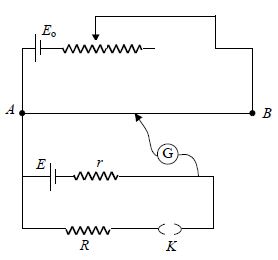
The given figure represents an arrangement of potentiometer for the calculation of internal resistance $(r)$ of the unknown battery $(E)$. The balance length is $70.0\, cm$ with the key opened and $60.0\,cm$ with the key closed. $R$ is $132.40 \Omega $. The internal resistance $(r)$ of the unknown cell will be.......$\Omega$ (Given $E_o > E$) :-
Light of wavelength $\lambda$ falls on a metal having work function $\frac{\text{h}_\text{c}}{\lambda_0}.$ Photoelectric effect will take place only if:
A ray of light travelling in water is incident on its surface open to air. The angle of incidence is $\theta$, which is less than the critical angle. Then there will be
Experimentally it is found that $12.8\,eV$ energy is required to separate a hydrogen atom into a proton and an electron. So the orbital radius of the electron in a hydrogen atom is $\frac{9}{ x } \times 10^{-10}\,m$. The value of the $x$ is $\left(1\,eV =1.6 \times 10^{-19}\,J , \frac{1}{4 \pi \in_0}=9 \times 10^9\,Nm ^2 / C ^2\right.$ and electronic charge $=1.6 \times 10^{-19}\,J\,C$ )
Select correct one
A series $\text{LCR}$ circuit is tuned to resonance. If the angular frequency of the applied $AC$ voltage at resonance is $\omega$ the impedance of the circuit then is:
A magnetic needle of negligible breadth and thickness compared to its length, oscillates in a horizontal plane with a period $T$. The period of oscillation of each part obtained on breaking the magnet into $n$ equal parts perpendicular to the length is
The period of oscillations of a magnet is $ 2 \,sec$. When it is remagnetised so that the pole strength is $4$ $times$ its period will be......$sec$