MCQ
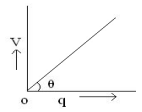
For an isolated object, the graph between potential and charge is given below. The capacity of an object is-
Image
  • A
    $\sin \theta$
  • B
    $\cos \theta$
  • C
    $\tan \theta$
  • $\cot \theta$

Answer

Correct option: D.
$\cot \theta$
D

Need a full question paper?

Generate a complete, print-ready paper with questions like this in minutes — across 16+ boards, with answer keys.
Start Generating Free

Similar questions

The speed of electromagnetic wave in vacuum depends upon the source of radiation(a) Increases as we move from g-rays to radio waves(b) Decreases as we move from g-rays to radio waves(c) Is same for all of them(d) None of these


A charged particle moves in a uniform magnetic field. The velocity of the particle at some instant makes an acute angle with the magnetic field. The path of the particle will be:
An electric dipole is placed at the centre of a sphere, choose the correct options:
Which of the following statements is/ are correct for equipotential surface ?
  1. The potential at all the points on an equipotential surface is same.
  2. Equipotential surfaces never intersect each other.
  3. Work done in moving a charge from one point to other on an equipotential surface is zero.
When a current passes through a wire whose different parts are maintained at different temperatures, evolution or absorption of heat all along the length of wire is known as(a) Joule effect(b) Seebeck effect(c) Peltier effect(d) Thomson effect
       
The transistor are usually made of:
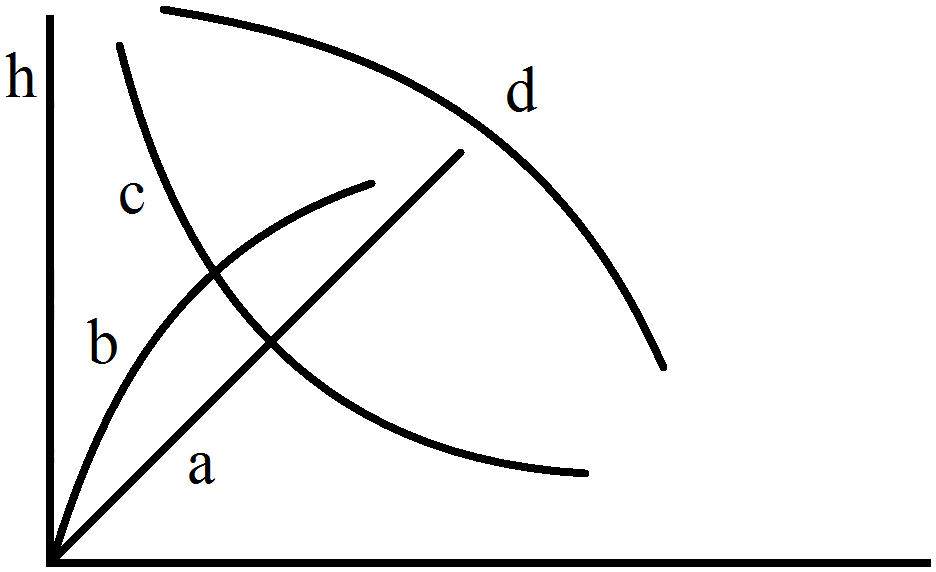
Which of the following graphs may represent the relation between the capillary rise h and the radius r of the capillary?
The photoelectric effect can be understood on the basis of(a) The principle of superposition(b) The electromagnetic theory of light(c) The special theory of relativity(d) Line spectrum of the atom
   
   
A glass convex lens $\left({\mu_{\mathrm{g}}}\right.= 1.5)$ has a focal length of $8 \ cm$ when placed in air. What would be the focal length of the lens when it is immersed in water $\left(\mu_{\mathrm{w}}=1.33\right)$
On rubbing, when one body gets positively charged and other negatively charged, the electrons transferred from positively charged body to negatively charged body are: