Question
For an LCR circuit driven at frequency $\omega$, the equation reads $\text{L}\frac{\text{di}}{\text{dt}}+\text{Ri}+\frac{\text{q}}{\text{C}}=\text{v}_\text{i}=\text{v}_\text{m}\sin\omega\text{t}$.
  1. Multiply the equation by i and simplify where possible.
  2. Interpret each term physically.
  3. Cast the equation in the form of a conservation of energy statement.
  4. Intergrate the equation over one cycle to find that the phase difference between v and i must be acute.
Answer

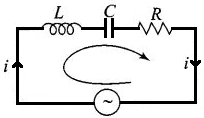
Applying KVL for the loop as shown in the figure, we can write

$\text{V}=\text{V}_\text{m}\sin\omega\text{t}$
$\Rightarrow\ \text{L}\frac{\text{di}}{\text{dt}}=\frac{\text{q}}{\text{C}}+\text{iR}=\text{V}_\text{m}\sin\omega\text{t}\ .....\text{(i)}$
Multiplying both sides by i, we get
$\text{L}\frac{\text{di}}{\text{dt}}=\frac{\text{q}}{\text{C}}\text{i}+\text{i}^2\text{R}=(\text{V}_\text{m}\text{i})\sin\omega\text{t}=\text{Vi}\ .....\text{(ii)}$
where $\text{Li}\frac{\text{di}}{\text{dt}}=\frac{\text{d}}{\text{dt}}\Big(\frac{1}{2}\text{Li}^2\Big)=$ rate of change of energy stored in an inductor.
Now, power loss in from of heat is given $i^2R$
$\frac{\text{q}}{\text{C}}\text{i}=\frac{\text{d}}{\text{dt}}\Big(\frac{\text{q}^2}{2\text{C}}\Big)=$ rate of chage of energy stored in the capacitor.
Vi = rate at which driving force pours in energy. It goes into (i) ohmic loss and (ii) increase of stored energy.
Hence Eq. (ii) is in the form of conservation of energy statement. Integrating both sides of Eq. (ii) with respect to time over one full cycle (0 → T) we may write
$\int_0^\text{T}\frac{\text{d}}{\text{dt}}\bigg(\frac{1}{2}\text{Li}^2+\frac{\text{q}^2}{2\text{C}}\bigg)\text{dt}+\int_0^\text{T}\text{Ri}^2\text{dt}=\int_0^\text{T}\text{Vi dt}$
$\Rightarrow\ 0+(+\text{ve})=\int_0^\text{T}\text{Vi dt}$
$\Rightarrow\ \int_0^\text{T}\text{Vi dt}>0$ if phase difference between V and i is a constant and acute angle.

Need a full question paper?

Generate a complete, print-ready paper with questions like this in minutes — across 16+ boards, with answer keys.

Start Generating Free

Similar questions

When a dielectric is placed in an electric field, it gets polarized. The electric field in a polarized material is less than the applied field. When a paramagnetic substance is kept in a magnetic field, the field in the substance is more than the applied field. Explain the reason of this opposite behaviour.
Explain the vector form of Coulomb's law and write its important facts.
The refractive index of a material $M_1$ changes by 0.014 and that of another material $M_2$ changes by 0.024 as the colour of the light is changed from red to violet. Two thin prisms one made of $M_1(A = 5.3^\circ)$ and other made of $M_2(A = 3.7^\circ)$ are combined with their refracting angles oppositely directed.
  1. Find the angular dispersion produced by the combination.
  2. The prisms are now combined with their refracting angles similarly directed. Find the angular dispersion produced by the combination.
Neglect the effect of rotation of the earth. Suppose the earth suddenly stops attracting objects placed near its surface. A person standing on the surface of the earth will:
  1. Fly up.
  2. Slip along the surface.
  3. Fly along a tangent to the earth's surface.
  4. Remain standing.
The conduction band of a solid is partially filled at 0K. Will it be a conductor, a semiconductor or an insulator?
A hollow tube has a length $l_1$ inner radius $R_1$ and outer radius $R_2$. The material has a thermal conductivity K. Find the heat flowing through the walls of the tube if.
  1. The flat ends are maintained at temperatures $T_1$ and $T_2(T_2 > T_1)$
  2. The inside of the tube is maintained at temperature $T_1$ and the outside is maintained at $T_2.$
The volume of a glass vessel is 1000 cc at $20^{\circ} \mathrm{C}$. What volume of mercury should be poured into it at this temperature so that the volume of the remaining space does not change with temperature? Coefficients of cubical expansion of mercury and glass are $1.8 \times 10^{-4}{ }^{\circ} \mathrm{C}$ and $9.0 \times 10^{-6}{ }^{\circ} \mathrm{C}^{-1}$ respectively.
A train running at 108km/h towards east whistles at a dominant frequency of 500Hz. Speed of sound in air is 340m/s.
  1. What frequency will a passenger sitting near the open window hear?
  2. What frequency will a person standing near the track hear whom the train has just passed?
  3. A wind starts blowing towards east at a speed f 36km/h. Calculate the frequencies heard by the passenger in the train and by the person standing near the track.
Two large conducting plates are placed parallel to each other and they carry equal and opposite charges with surface density $\sigma$ as shown in figure. Find the electric field:
  1. At the left of the plates.
  2. In between the plates.
  3. At the right of the plates.
A capacitor having a capacitance of $100\mu\text{F}$ is charged to a potential difference of 24V. The charging battery is disconnected and the capacitor is connected to another battery of emf 12V with the positive plate of the capacitor joined with the positive terminal of the battery:
  1. Find the charges on the capacitor before and after the reconnection.
  2. Find the charge flown through the 12V battery.
  3. Is work done by the battery or is it done on the battery? Find its magnitude.
  4. Find the decrease in electrostatic field energy.
  5. Find the heat developed during the flow of charge after reconnection.