The refractive index of a material $M_1$ changes by 0.014 and that of another material $M_2$ changes by 0.024 as the colour of the light is changed from red to violet. Two thin prisms one made of $M_1(A = 5.3^\circ)$ and other made of $M_2(A = 3.7^\circ)$ are combined with their refracting angles oppositely directed.
- Find the angular dispersion produced by the combination.
- The prisms are now combined with their refracting angles similarly directed. Find the angular dispersion produced by the combination.
Download our app for free and get started
Given that, $\mu'_\text{v}-\mu'_\text{r}=0.014$ and $\mu_\text{v}-\mu_\text{r}=0.024$ $\text{A}' = 5.3^\circ\ \text{and A} = 3.7^\circ$
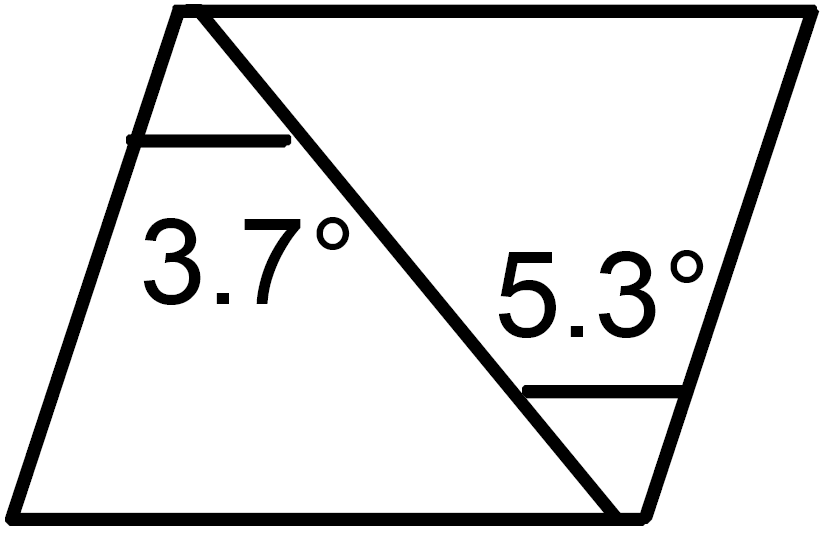
angular dispersion $=(\mu_\text{v}-\mu_\text{r})\text{A}-(\mu'_\text{v}-\mu'_\text{r})\text{A}'$
$=0.024\times3.7^\circ-0.014\times5.3^\circ=0.0146^\circ$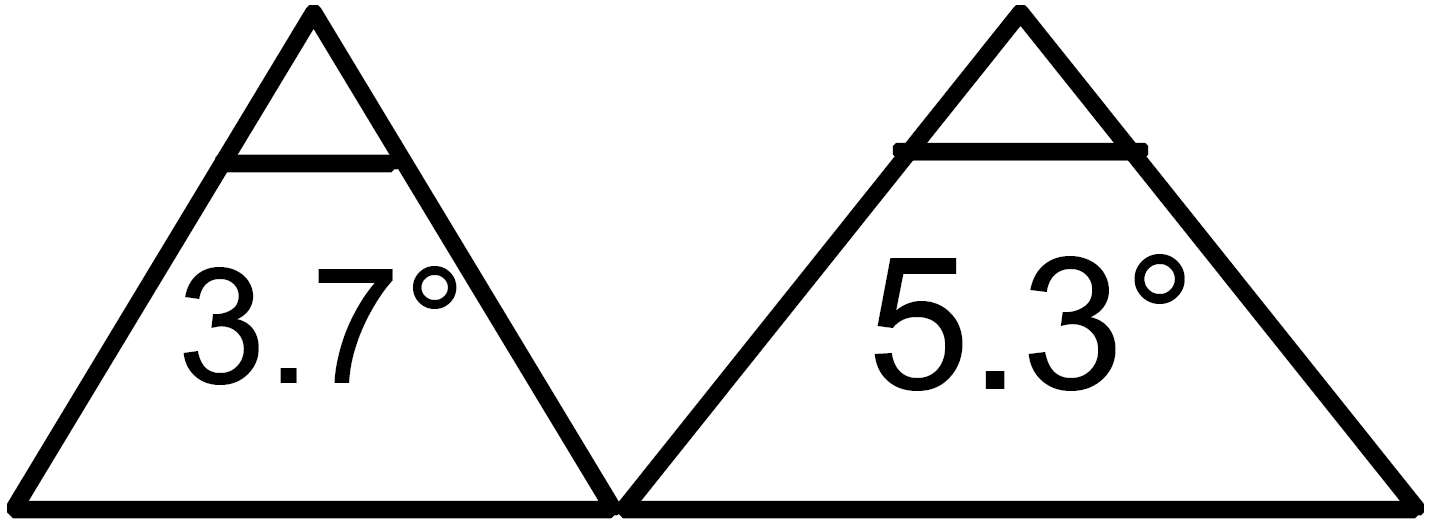
angular dispersion $=(\mu_\text{v}-\mu_\text{r})\text{A}+(\mu'_\text{v}-\mu'_\text{r})\text{A}'$
$=0.024\times3.7^\circ+0.014\times5.3^\circ=0.163^\circ$
- When the prisms are oppositely directed,
angular dispersion $=(\mu_\text{v}-\mu_\text{r})\text{A}-(\mu'_\text{v}-\mu'_\text{r})\text{A}'$
$=0.024\times3.7^\circ-0.014\times5.3^\circ=0.0146^\circ$
- When they are similarly directed,
angular dispersion $=(\mu_\text{v}-\mu_\text{r})\text{A}+(\mu'_\text{v}-\mu'_\text{r})\text{A}'$
$=0.024\times3.7^\circ+0.014\times5.3^\circ=0.163^\circ$

Download our appand get started for free
Experience the future of education. Simply download our apps or reach out to us for more information. Let's shape the future of learning together!No signup needed.*
Similar Questions
- 1A right angled prism of refractive index n has a plane of refractive index $n_1$ so that $n_1 < n$, cemented to its diagonal face. The assembly is in air. A ray is incident on AB.View Solution
- Calculate the angle of incidence at AB for which the ray strikes the diagonal face at the critical angle.
- Assuming n = 1.352, calculate the angle of incidence at AB for which the refracted ray passes through the diagonal face undeviated.
- 2View SolutionA convex lens has a focal length of 10cm. Find the location and nature of the image if a point object is placed on the principal axis at a distance of:
- 9.8cm
- 10.2cm from the lens.
- 3View Solution
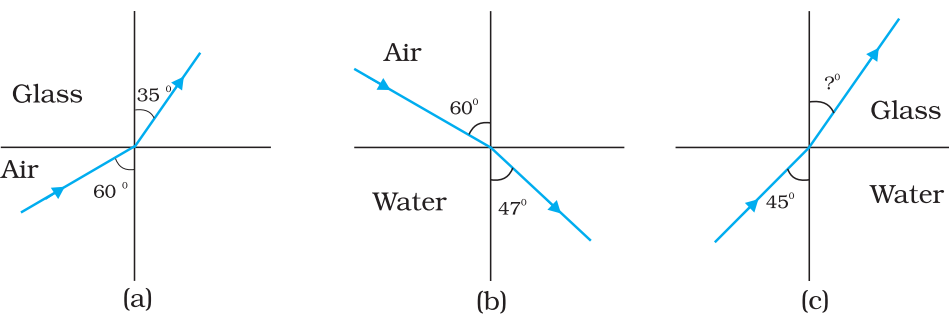
(a) and (b) show refraction of a ray in air incident at 60° with the normal to a glass-air and water-air interface, respectively. Predict the angle of refraction in glass when the angle of incidence in water is 45º with the normal to a water - glass interface.
- 4View SolutionA converging lens of focal length 15cm and a converging mirror of focal length 10cm are placed 50cm apart. If a pin of length 2.0cm is placed 30cm from the lens farther away from the mirror, where will the final image form and what will be the size of the final image?
- 5A small block of mass m and a concave mirror of radius R fitted with a stand lie on a smooth horizontal table with a separation d between them. The mirror together with its stand has a mass m. The block is pushed at t = 0 towards the mirror so that it starts moving towards the mirror at a constant speed V and collides with it. The collision is perfectly elastic. Find the velocity of the image:View Solution
- At a time $\text{t}<\frac{\text{d}}{\text{V}}$
- At a time $\text{t}>\frac{\text{d}}{\text{V}}.$
- 6View SolutionDetermine the ‘effective focal length’ of the combination of the two lenses in if they are placed 8.0 cm apart with their principal axes coincident. Does the answer depend on which side of the combination a beam of parallel light is incident? Is the notion of effective focal length of this system useful at all.
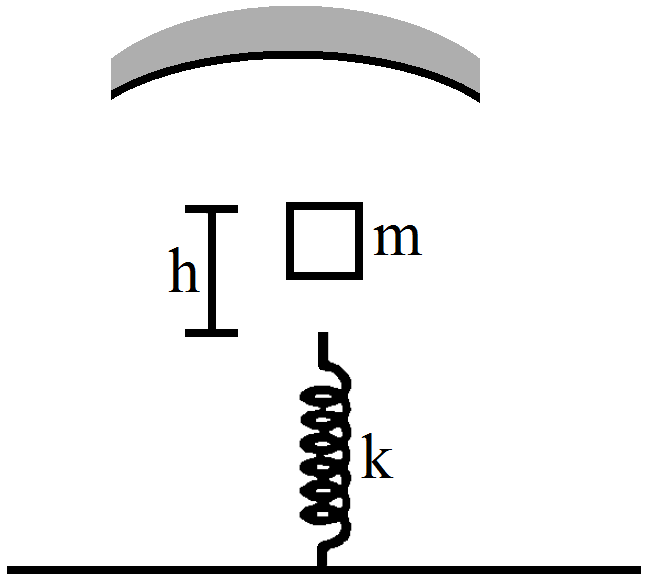
- 7View SolutionA mass m = 50g is dropped on a vertical spring of spring constant 500N/m from a height h = 10cm as shown in figure. The mass sticks to the spring and executes simple harmonic oscillations after that. A concave mirror of focal length 12cm facing the mass is fixed with its principal axis coinciding with the line of motion of the mass, its pole being at a distance of 30cm from the free end of the spring. Find the length in which the image of the mass oscillates.
- 8View SolutionHow is the working of a telescope different from that of a microscope?
The focal lengths of the objective and eyepiece of a microscope are 1.25 cm and 5 cm respectively. Find the position of the object relative to the objective in order to obtain an angular magnification of 30 in normal adjustment. - 9A ball is kept at a height h above the surface of a heavy transparent sphere made of a material of refractive index $\mu.$ The radius of the sphere is R. At t = 0, the ball is dropped to fall normally on the sphere. Find the speed of the image formed as a function of time for $\text{t}<\sqrt{\frac{2\text{h}}{\text{g}}}.$ Consider only the image by a single refraction.View Solution
- 10View SolutionA circular disc of radius 'R' is placed co-axially and horizontally inside an opaque hemispherical bowl of radius 'a' (Fig). The far edge of the disc is just visible when viewed from the edge of the bowl. The bowl is filled with transparent liquid of refractive index μ and the near edge of the disc becomes just visible. How far below the top of the bowl is the disc placed?