MCQ
For an object projected from ground with speed $u$ horizontal range is two times the maximum height attained by it. The horizontal range of object is ..........
  • A
    $\frac{2 u^2}{3 g}$
  • B
    $\frac{3 u^2}{4 g}$
  • C
    $\frac{3 u^2}{2 g}$
  • $\frac{4 u^2}{5 g}$

Answer

Correct option: D.
$\frac{4 u^2}{5 g}$
d
(d)

$R=24$ also,$\frac{H}{R}=\frac{1}{4} \tan \theta$

$\frac{H}{R}=\frac{1}{2} \Rightarrow \frac{1}{2}=\frac{1}{4} \tan \theta$

$\tan \theta=2=\frac{P}{B}$

$R=\frac{2 u^2 \sin \theta \cos \theta}{g}$

$R=\frac{2 u^2}{g} \cdot \frac{2}{\sqrt{5}} \times \frac{1}{\sqrt{5}}$

$R=\frac{4 u^2}{5 g}$

Need a full question paper?

Generate a complete, print-ready paper with questions like this in minutes — across 16+ boards, with answer keys.

Start Generating Free

Similar questions

At which temperature the r.m.s. velocity of a hydrogen molecule equal to that of an oxygen molecule at $47^{\circ} \mathrm{C}$ ?
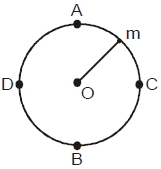
A mass is performing vertical circular motion (see figure). If The average velocity of the particle is increased, then at which point the string will break
A cubical block of mass M and edge a slides down a rough inclined plane of inclination $\theta$ with a uniform velocity. The torque of the normal force on the block about its centre has a magnitude:
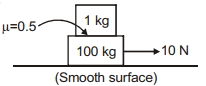
The frictional force acting on $1 \,kg$ block is .................. $N$
A balloon of mass $m$ is descending down with an acceleration $\frac{g}{2}$.  How much mass should be removed from it so that it starts moving up with same acceleration?
A hospital uses an ultrasonic scanner to locate tumours in a tissue. The operating frequency of the scanner is $4.2 MHz$. The speed of sound in a tissue is $1.7 \,km-s^{-1}$. The wavelength of sound in the tissue is close to
A boy standing at the top of a tower of $20\, m$ height drops a stone . Assuming $g = 10 \,ms^{-2,}$ the velocity with which it hits the ground is.........$ms^{-1}$
person trying to lose weight by burning fat lifts a mass of $10\ kg$ upto a height of $1\ m$ $1000$ times. Assume that the potential energy lost each time he lowers the mass is dissipated. How much fat will he use up considering the work done only when the weight is lifted up? Fat supplies $3.8 \times 10^7\ J$ of energy per kg which is converted to mechanical energy with a $20\%$ efficiency rate. Take $g=9.8$ $ms^{-2}$ 
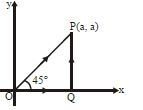
A particle is moved from $(0, 0)$  to $(a, a)$  under a force $F = (3\hat i + 4\hat j)$ from two paths. Path $1$ is $OP$ and path $2$  is $OQP$ . Let $W_1$ and $W_2$ be the work done by this force in these two paths respectively. Then
A body is executing $S.H.M.$ When its displacement from the mean position is $4\, cm$ and $5\, cm$, the corresponding velocity of the body is $10 \,cm/sec$ and $8\, cm/sec$. Then the time period of the body is