MCQ
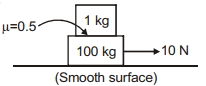
The frictional force acting on $1 \,kg$ block is .................. $N$
  • $0.1$
  • B
    $2$
  • C
    $0.5$
  • D
    $5$

Answer

Correct option: A.
$0.1$
a
(a)

If both move together $a=\frac{10}{101} \simeq 0.1 \,m / s ^2$

Now, $F_{\text {net }}=1(0.1)=0.1 \,N$

$f_L=(0.5)(1)(g)=5 \,N$

So, $f=0.1 \,N$

Need a full question paper?

Generate a complete, print-ready paper with questions like this in minutes — across 16+ boards, with answer keys.
Start Generating Free

Similar questions

The coefficient of restitution $e$ for a perfectly inelastic collision is
A point charge q is rotated along a circle in the electric field generated by another point charge Q. The work done by the electric field on the roatating charge in one complete revolution is:
A large cylindrical rod of length $L$ is made by joining two identical rods of copper and steel of length $(\frac {L}{2})$ each . The rods are completely insulated from the surroundings. If the free end of copper rod is maintained at $100\,^oC$ and that of steel at $0\,^oC$ then the temperature of junction is........$^oC$ (Thermal conductivity of copper is $9\,times$ that of steel)
A motor car is going due north at a speed of 50km/h. It makes a 90° left turn without changing the speed. The change in the velocity of the car is about:
A body is performing simple harmonic with an amplitude of $10 \,cm$. The velocity of the body was tripled by air Jet when it is at $5 \,cm$ from its mean position. The new amplitude of vibration is $\sqrt{ x } \,cm$. The value of $x$ is________
Beats are produced by two waves ${y_1} = a\sin 1000\,\pi t,$ ${y_2} = a\sin 998\pi t$The number of beats heard/sec is
Which of the following types of motion cannot describe the motion of a clock’s hands?
To maintain a speed of $80\,km / h$ by a bus of mass $500\,kg$ on a plane rough road for $4\,km$ distance, the work done by the engine of the bus will be $........\,kJ$. [The coefficient of friction between tyre of bus and road is $0.04]$.
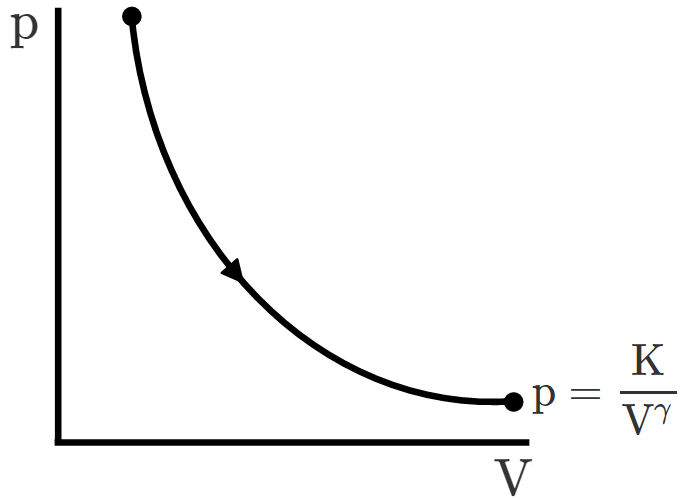
The molar heat capacity for the process shown in the figure is:
A binary star system consists of two stars one of which has double the mass of the other. The stars rotate about their common centre of mass :-