Question
For any positive integer n, prove that $n^3 - n$ is divisible by $6.$

Answer

Let $n = 6q or 6q + 1, 6q + 2, 6q + 3 ... 6q + 5$
If $n = 6q$, then
Then $n^3 - n = (6q)^3 - 6q = 216q^3 - 6q$
$= 6 (36q^3 - q)$
Which is divisible by 6
If $n = 6q + 1$, then
$n^3 - n = (6q + 1)^3 - (6q + 1)$
$= 216q^3 + 108q^2 + 18q + 1 - 6q - 1$
$= 216q^3 + 108q^2 + 12q$
$= 6(36q^3 + 18q^2 + 2q)$
Which is also divisible by 6
If $n = 6q + 2,$ then
$n^3 - n = (6q + 2)^3 - (6q + 2)$
$= 216q^3 + 216q^2 + 72q + 8 - 6q - 2$
$= 216q^3 + 216q^2 + 66q + 6$
$= 6(36q^3 + 36q^2 + 11q + 1)$
Which is divisible by $6$
Hence we can similarly, prove that $n^2 - n$ is divisible by $6$ for any positive integer n.
Hence proved.

Need a full question paper?

Generate a complete, print-ready paper with questions like this in minutes — across 16+ boards, with answer keys.

Start Generating Free

Similar questions

Find the mean of each of the following frequency distributions:
Class interval
$0-10$
$10-20$ $20-30$ $30-40$ $40-50$
Frequency
$9$ $12$
$15$
$10$
$14$
The $26^{th}, 11^{th}$​​​​​​​ and the last term of an AP are $0, 3$ and $-\frac{1}{5},$ respectively. Find the common difference and the number of terms.
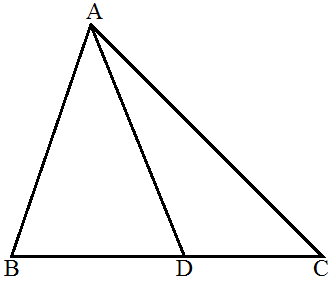
In FIg. check whether AD is the bisector of $\angle\text{A}$ of $\triangle\text{ABC}$ in the following:

AB = 5cm, AC = 10cm, BD = 1.5cm and CD = 3.5cm.
Line 4x + y = 4 divides the line segment joining the points (−2, −1) and (3,5)in a certain ratio. Find the ratio.
Evaluate the following:
$ \frac{\tan^260^\circ+4\cos^245^\circ+3\sec^230^\circ+5\cos^290^\circ}{\text{cosec30}^\circ+\sec60^\circ-\cot^230^\circ}$
Find whether the following equations have real roots. If real roots exist, find them.
$-2x^2 + 3x + 2 = 0.$
A right circular cone and a right circular cylinder have equal base and equal height. If the radius of the base and height are in the ratio 5 : 12, write the ratio of the total surface area of the cylinder to that of the cone.
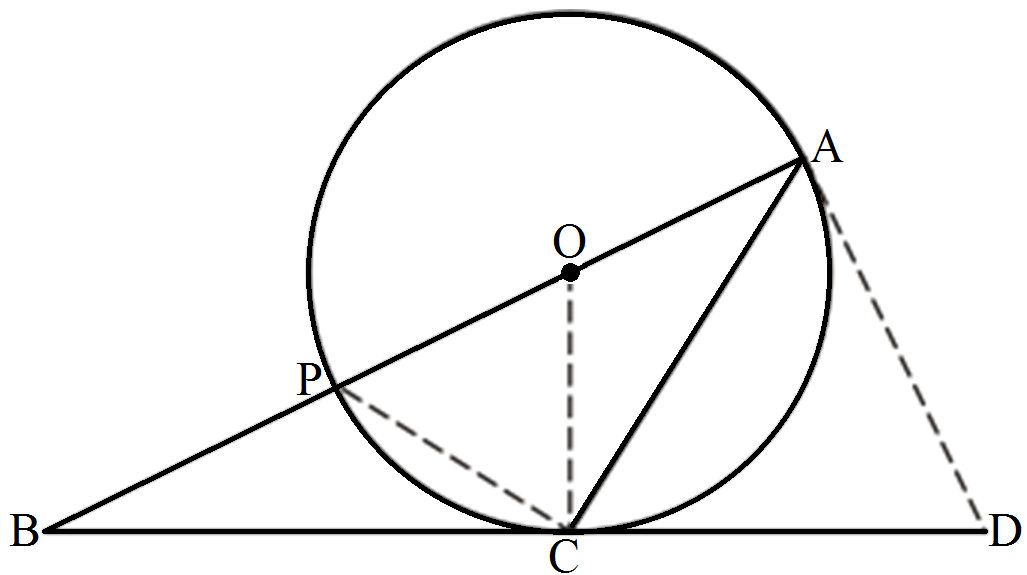
In the given figure, O is the centre of the circle and BCD is tangent to it at C. Prove that $\angle\text{BAC}+\angle\text{ACD}=90^{\circ}.$
Solve the following quadratic equations by factorization: $x^2-x-a(a+1)=0$
A circus tent is cylindrical to a height of 3 metres and conical above it. If its diameter is 105 m and the slant height of the conical portion is 53m, calculate the length of the canvas 5m wide to make the required tent.