MCQ
For Carnot engine, which process should be chosen to take the working substance from $T_1$ to $T_2$ or vice$-$versa?
  • A
    Isochoric.
  • B
    Isothermal.
  • Adiabatic.
  • D
    Isobaric.

Answer

Correct option: C.
Adiabatic.

Need a full question paper?

Generate a complete, print-ready paper with questions like this in minutes — across 16+ boards, with answer keys.

Start Generating Free

Similar questions

Column $I$ describe some situations in which a small object moves. Column $II$ describes some characteristics of these motions. Match the situation in Column $I$ with the characteristics in Column $II$ and indicate your answer by darkening appropriate bubbles in the $4 \times 4$ matrix given in the $ORS$.
Column $I$ Column $II$
$(A)$ The object moves on the $\mathrm{x}$-axis under a conservative force in such a way that its "speed" and "position" satisfy $v=c_1 \sqrt{c_2-x^2}$, where $\mathrm{c}_1$ and $\mathrm{c}_2$ are positive constants. $(p)$ The object executes a simple harmonic motion.
$(B)$ The object moves on the $\mathrm{x}$-axis in such a way that its velocity and its displacement from the origin satisfy $\mathrm{v}=-\mathrm{kx}$, where $\mathrm{k}$ is a positive constant. $(q)$ The object does not change its direction.
$(C)$ The object is attached to one end of a massless spring of a given spring constant. The other end of the spring is attached to the ceiling of an elevator. Initially everything is at rest. The elevator starts going upwards with a constant acceleration a. The motion of the object is observed from the elevator during the period it maintains this acceleration. $(r)$ The kinetic energy of the object keeps on decreasing.
$(D)$ The object is projected from the earth's surface vertically upwards with a speed $2 \sqrt{\mathrm{GM}_e / R_e}$, where, $M_e$ is the mass of the earth and $R_e$ is the radius of the earth. Neglect forces from objects other than the earth. $(s)$ The object can change its direction only once.
Two wires of same length and radius are joined end to end and loaded. The Young's modulii of the materials of the two wires are $Y_{1}$ and $Y_{2}$. The combination behaves as a single wire then its Young's modulus is:
Two particles $A$ and $B$, initially at rest, moves towards each other under a mutual force of attraction. At the instant when the speed of $A$ is $u$ and the speed of $B$ is $2u$, the speed of centre of mass is:
A copper block of mass $5.0\, kg$ is heated to a temperature of $500^{\circ} C$ and is placed on a large ice block. What is the maximum amount of ice (ઇન $kg$) that can melt? [Specific heat of copper: $0.39\, Jg ^{-1 \circ} C ^{-1}$ and latent heat of fusion of water : $335 \,J g ^{-1}$ ]
While measuring the thermal conductivity of a liquid, we keep the upper part hot and lower part cool, so that
A system is provided with $200$ cal of heat and the work done by the system on the surroundings is $40J.$ Then, its internal energy:
A mass of $10 \,kg$ is suspended vertically by a rope of length $5 \,m$ from the roof. A force of $30 \,N$ is applied at the middle point of rope in horizontal direction. The angle made by upper half of the rope with vertical is $\theta=\tan ^{-1}\left(x \times 10^{-1}\right)$. The value of $x$ is ................

$\text { (Given } g =10 \,m / s ^{2} \text { ) }$
The momentum $p$ (in $kg m / s )$ of a particle is varying with time $t$ (in $s )$ as $p=2+3 t^2$. The force acting on the particle at $t=3 s$ will be ......... $N$
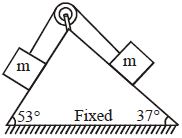
Two blocks which are connected to each other by means of a massless string are placed  on two inclined planes as shown in figure. After releasing from rest, the magnitude of  acceleration of the centre of mass of both the blocks is $(g = 10\, m/s^2)$
Four rods of indentical cross-sectional area and made from the same metal form the sides of a square. The temperature of two diagonally opposite points are $\theta$ and $\sqrt2 \theta$ respectively in the  teady state. Assuming that only heat conduction takes place, what will be the temperature difference between other two points ?