MCQ
For electron moving in $n$ orbit of $H$-atom the angular velocity is proportional to
  • A
    $n/1$
  • B
    $1 / n$
  • C
    $n$
  • $1 / n$

Answer

Correct option: D.
$1 / n$

Need a full question paper?

Generate a complete, print-ready paper with questions like this in minutes — across 16+ boards, with answer keys.

Start Generating Free

Similar questions

When a body is moving on a surface, the force of friction is called
The pointer of a dead-beat galvanometer gives a steady deflection because
$41$ forks are so arranged that each produces $5$ beats per sec when sounded with its near fork. If the frequency of last fork is double the frequency of first fork, then the frequencies of the first and last fork are respectively
$A$ galvanometer may be converted into ammeter or voltmeter. In which of the following cases the resistance of the device will be the largest ? (Asssume maximum range of galvanometer $= 1\, mA$)
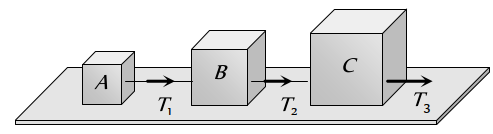
Three blocks $A, B$ and $C$ weighing $1,8$ and $27\ kg$ respectively are connected as shown in the figure with an inextensible string and are moving on a smooth surface. $T_3$ is equal to $36\ N$. Then $T_2$ isImage
The length of a spring is $l$ and its force constant is $k$. When a weight $W$ is suspended from it, its length increases by $x$. If the spring is cut into two equal parts and put in parallel and the same weight $W$ is suspended from them, then the extension will be
Specific rotation of sugar solution is $0.01 Sl$ units. $200 kgm ^{-3}$ of impure sugar solution is taken in a polarimeter tube of length $0.25 m$ and an optical rotation of $0.4 rad$ is observed. The percentage of purity of sugar is the sample is
The diagrams represent the potential energy $U$ of a function of the inter-atomic distance $r$. Which diagram corresponds to stable molecules found in nature.
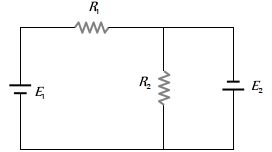
Two resistances $R_1$ and $R_2$ are joined as shown in the figure to two batteries of $\text{e.m.f}. E_1$ and $E_2$. If $E_2$ is short $-$ circuited, the current through $R_1$ isImage
The variation of the acceleration $a$ of the particle executing S.H.M. with displacement $y$ is as shown in the figure