For going to a city B from city A, there is a route via city C such that $\text{AC}\perp\text{CB},$ AC = 2x km and CB = 2(x + 7)km. It is proposed to construct a 26km highway which directly connects the two cities A and B. Find how much distance will be saved in reaching city B from city A after the construction of the highway.
Download our app for free and get started
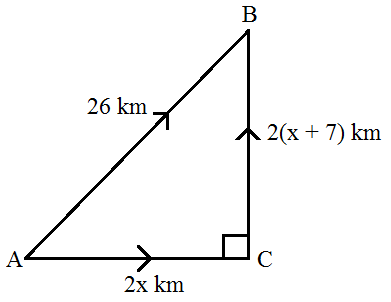
Distance saved by direct highway = (AC + BC) - AB
$\therefore\text{AC}\perp\text{CB}$ so by pythagoras theorem
$AC^2 + BC^2 = AB^2$
$\Rightarrow (2x)^2 + [2(x + 7)]^2 = 26^2$
$\Rightarrow 2^2x^2 + 2^2(x + 7)^2 = 676$
$\Rightarrow 4x^2 + 4(x^2 + 49 + 14x) = 676$
$\Rightarrow 4[x^2 + x^2 + 49 + 14x] = 676$
$\Rightarrow2\text{x}^2+14\text{x}+49=\frac{676}{4}$
$\Rightarrow 2x^2 + 14x + 49 = 169$
$\Rightarrow 2x^2 + 14x + 49 = 169$
$\Rightarrow 2x^2 + 14x + 49 - 169 = 0$
$\Rightarrow 2x^2 + 14x - 120 = 0$
$\Rightarrow x^2 + 7x - 60 = 0$
$\Rightarrow x^2 + 12x - 5x - 60 = 0$
$\Rightarrow x(x + 12) - 5(x + 12) = 0$
$\Rightarrow (x + 12)(x - 5) = 0$
$\Rightarrow x + 12 = 0 or x - 5$
$\Rightarrow x = -12 or x = 5$
$\Rightarrow x = -12$(rejected)
$\because\text{x}=5$
$\therefore$ The required distance $= AC + BC - AB$
$= 2x + 2x + 14 - 26$
$= 4x - 12 $$[\because\text{x}=5]$
$= 4 × 5 - 12$
$= 20 - 12$
= 8km
Hence, the distance saved by highway is 8km.

Download our appand get started for free
Experience the future of education. Simply download our apps or reach out to us for more information. Let's shape the future of learning together!No signup needed.*
Similar Questions
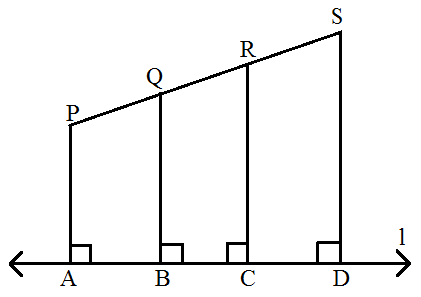
- 1View SolutionIn PA, QB, RC and SD are all perpendiculars to a line l, AB = 6cm, BC = 9cm, CD = 12cm and SP = 36cm. Find PQ, QR and RS.
- 2View SolutionProve that the area of the semicircle drawn on the hypotenuse of a right angled triangle is equal to the sum of the areas of the semicircles drawn on the other two sides of triangle.
- 3View SolutionABCD is a trapezium in which AB || DC and P and Q are points on AD and BC, respectively such that PQ || DC. If PD = 18cm, BQ = 35cm and QC = 15cm, find AD.
- 4View SolutionO is the point of intersection of the diagonals AC and BD of a trapezium ABCD with AB || DC. Through O, a line segment PQ is drawn parallel AB meeting AD in P and BC in Q. Prove that PO = QO.
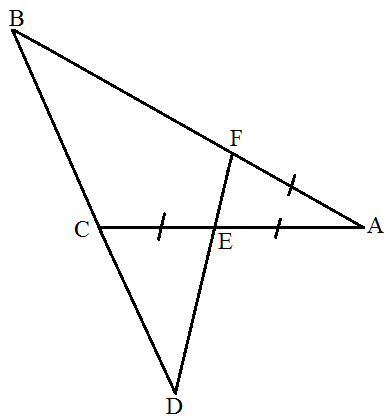
- 5In line segment DF intersect the side AC of a triangle ABC at the point E such that E is the mid-point of CA and $\angle\text{AEF}=\angle\text{AFE}.$ Prove that $\frac{\text{BD}}{\text{CD}}=\frac{\text{BF}}{\text{CE}}.$View Solution
[Hint: Take point G on AB such that CG || DF]
- 6View SolutionA 5m long ladder is placed leaning towards a vertical wall such that it reaches the wall at a point 4m high. If the foot of the ladder is moved 1.6m to towards the wall, then find the distance by which the top of the ladder would slide upwards on the wall.
- 7View SolutionIf PQRS is a parallelogram and AB || PS, then prove that OC || SR.
- 8In a $\triangle\text{PQR},\text{PR}^2-\text{PQ}^2=\text{QR}^2$ and M is a point on side PR such that $\text{QM}\perp\text{PR}$ Provr that- $QM^2 = PM \times MR.$View Solution
- 9View SolutionProve that the area of the equilateral triangle drawn on the hypotenuse of a right angled triangle is equal to the sum of the areas of the equilateral triangles drawn on the other two sides of the triangle.
- 10In $\angle\text{A}=\angle\text{C},$ AB = 6cm, BP = 15cm, AP = 12cm and CP = 4cm, then find the lengths of PD and CD.View Solution