Question
For harder X-rays:
  1. The wavelength is higher.
  2. The intensity is higher.
  3. The frequency is higher.
  4. The photon energy is higher.

Answer

  1. The frequency is higher.
  2. The photon energy is higher.
Explanation:
Harder X-rays are the X-rays having low wavelengths. Since the frequency varies inversely with the wavelength, hard X-rays have high frequency.
Energy of a photon (E) is given by
$\text{E}=\frac{\text{hc}}{\lambda}$
Here,
h = Planck's constant
c = Speed of light
$\lambda$ = Wavelength of light.
Clearly, energy varies inversely with wavelength. Therefore, the energy of the photon will be higher for the hard X-ray.

Need a full question paper?

Generate a complete, print-ready paper with questions like this in minutes — across 16+ boards, with answer keys.
Start Generating Free

Similar questions

Semiconductor is damaged by the strong current due to(a) Lack of free electron(b) Excess of electrons(c) Excess of proton(d) None of these
   
   
A magnetic needle kept parallel to a magnetic field requires a work W to be rotated by 60. The necessary torque required to keep the needle in this position is:
In angle of prism and angle of minimum deviation each is A then the refractive index of the material of the prism will be :
If the mass of neutron $=1.7\times 10−27\ kg .$ Then the de broglie wavelength of neutron of energy $3\text{eV}$ is:
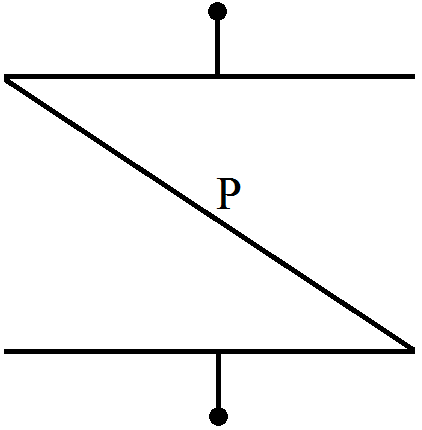
A thin metal plate P is inserted between the plates of a parallel-plate capacitor of capacitance C in such a way that its edges touch the two plates (figure). The capacitance now becomes:
The diffusion current in a p-n junction is:
In an AC generator, a coil with N turns, all of the same area A and total resistance R, rotates with frequency 1rad/ s in a magnetic field B. The maximum value of emf generated in the coil is:
When a 12 Ω resistor is connected with a moving coil galvanometer then its deflection reduces from 50 divisions to 10 divisions. The resistance of the galvanometer is(a) 24 Ω(b) 36 Ω(c) 48 Ω(d) 60 Ω
       
The material of permanent magnet has(a) High retentivity, low coercivity(b) Low retentivity, high coercivity(c) Low retentivity, low coercivity(d) High retentivity, high coercivity
   
   
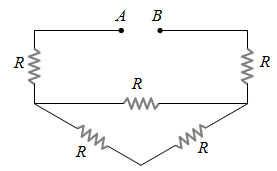
What is the equivalent resistance between $A$ and $B$ in the figure below if $R = 3 \Omega$