MCQ
For nuclei with A > 100:
  • A
    The binding energy of the nucleus decreases on an average as A increases.
  • B
    The binding energy per nucleon decreases on an average as A increases.
  • C
    If the nucleus breaks into two roughly equal parts, energy is released.
  • B and C both

Answer

Correct option: D.
B and C both
Explanation:
Binding energy per nucleon varies in a way that it depends on the actual value of mass number (A). As the mass number (A) increases, the binding energy also increases and reaches its maximum value of 8.7MeV for A(50-80) and for A > 100. The binding energy per nucleon decreases as A increases and the nucleus breaks into two or more atoms of roughly equal parts so as to attain stability and binding energy of mass number between 50-80.

Need a full question paper?

Generate a complete, print-ready paper with questions like this in minutes — across 16+ boards, with answer keys.

Start Generating Free

Similar questions

The transition of electron from $n = 4, 5, 6, .......$ to $n = 3$ corresponds to:
A parallel plate capacitor has plate area $A$ and separation $d$. It is charged to a potential difference $V_o$. The charging battery is disconnected and the plates are pulled apart to three times the initial separation. The work required to separate the plates is
Light of wavelength $\lambda$ strikes a photoelectric surface and electrons are ejected with kinetic energy $K$. If $K$ is to be increased to twice its original value, the wavelength must be changed to $\lambda'$ such that :-
$A.$ Current flow inside the capacitor due to accumulation of charges on the capacitor walls is called displacement current.
$B.$ Current due to the flow of electrons due to some potential difference is called as conduction current.
$C.$ Displacement current came into existence when Maxwell observed that if a magnetic compass is placed between the capacitors the needle gets deflected which signifies presence of magnetic fields which would possibly caused due to some changing current.
$D.$ Displacement current change the actual motion of electric charges.
Which of the above statement(s) is/ are correct?
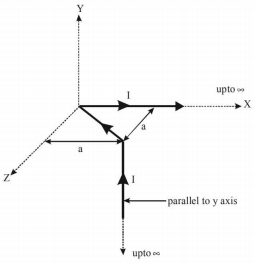
The magnetic field at the origin due to the current flowing in the wire is -
The particle that possesses half integral spin as
Three condensers of capacity $2 \mu F, 4 \mu F$ and $8 \mu F$ respectively, are first connected in series and then connected in parallel. The ratio of the equivalent capacitance in the two cases will be
The maximum electric field that can be held in air without producing ionisation of air is $10^7\,V/m$. The maximum potential therefore, to which a conducting sphere of radius $0.10\,m$ can be charged in air is
In saloons, there is always a characteristics smell due to the ammonia-based chemicals used in hair dyes and other products. Assume the initial concentration of ammonia molecules to be $1000 \,molecules/ m ^3$. Due to air ventilation, the number of molecules leaving in one minute is one tenth of the molecules present at the start of that minute. How long will it take for the concentration of ammonia molecules to reach $1 \,molecule / m ^3$ ?
A charged particle enters in a uniform magnetic field with a certain velocity. The power delivered to the particle by the magnetic field depends on: