MCQ
For one electron vacancy,
- Ano holes are created
- B1 hole is created
- C2 holes are created
- D4 holes are created
Explanation:
For one electron vacancy, an empty space or void is created. In order to fill that empty space, a charge carrier with a charge equal in magnitude but opposite polarity should occupy that space in order to maintain electrical neutrality. Such a charge particle is called a hole.
Generate a complete, print-ready paper with questions like this in minutes — across 16+ boards, with answer keys.
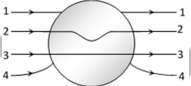
A light ray is incident by grazing one of the face of a prism and after refraction ray does not emerge out, what should be the angle of prism while critical angle is C
|
(a) Equal to 2C |
(b) Less than 2C |
(c) More than 2C |
(d) None of the above |
Two circuits have mutual inductance of 0.1 H. What average e.m.f. is induced in one circuit when the current in the other circuit changes from 0 to 20 A in 0.02 s
|
(a) 240 V |
(b) 230 V |
(c) 100 V |
(d) 300 V |
Which of the following statement is incorrect
|
(a) Both ac and dc dynamo have a field magnet |
|
(b) Both ac and dc dynamo have an armature |
|
(c) Both ac and dc dynamo convert mechanical energy into electrical energy |
|
(d) Both ac and dc dynamo have slip rings |
Assertion : Short wave bands are used for transmission of ratio waves to a large distance
Reason : Short waves are reflected by ionosphere
|
(a) If both assertion and reason are true and the reason is the correct explanation of the assertion. |
|
(b) If both assertion and reason are true but reason is not the correct explanation of the assertion. |
|
(c) If assertion is true but reason is false. |
| (d) If assertion is false but reason is true. |
The output of OR gate is 1
|
(a) If both inputs are zero |
(b) If either or both inputs are 1 |
|
(c) Only if both input are 1 |
(d) If either input is zero |