MCQ
For question two statements are given $-$ one labelled Assertion and the other labelled Reason. Select the correct answer to these questions from the codes $(a), (b), (c)$ and $(d)$ as given below.
Assertion : Alpha diversity is said to be higher if the dissimilarity between communities is higher.
Reason : Alpha diversity is a measure of diversity between the communities.
  • A
    Both assertion and reason are true and reason is the correct explanation of assertion.
  • B
    Both assertion and reason are true but reason is not the correct explanation of assertion.
  • C
    Assertion is true but reason is false.
  • Both assertion and reason are false.

Answer

Correct option: D.
Both assertion and reason are false.
Diversity at the level of community and ecosystem has three perspectives which are called Alpha, Beta and Gamma diversity. Alpha diversity $($within $-$ community diversity$)$ refers to the diversity of organisms sharing the same community/ habitat. A combination of species richness and equitability/ evenness is used to represent diversity within a community or habitat. Species richness is the number of species per unit area. The number of species increases with the area of the site. Generally, greater the species richness, greater is the species diversity. However, number of individuals among the species may also vary, resulting into differences in evenness or equitability and consequently in diversity.
Species frequently change when habitat or community changes. The rate of replacement of species along a gradient of habitats or communities is called beta diversity $($between $-$ community diversity$)$. There are differences in species composition of communities along environmental gradients, e.g., altitudinal gradient, moisture gradient, etc. Higher the heterogeneity in the habitats in a region or greater the dissimilarlty between communities, higher is the beta diversity. Diversity of the habitats over the total landscape or geographical area is called gamma diversity.

Need a full question paper?

Generate a complete, print-ready paper with questions like this in minutes — across 16+ boards, with answer keys.

Start Generating Free

Similar questions

Number of rice varieties developed by ancient Indians was :
For question two statements are given $-$ one labelled Assertion and the other labelled Reason. Select the correct answer to these questions from the codes $(a), (b), (c)$ and $(d)$ as given below.
Assertion : Ectotherms are able to remain active under cold conditions.
Reason : Ectotherms are able to maintain a constant internal temperature, even when the temperature outside fluctuates.
For question two statements are given$-$one labelled Assertion and the other labelled Reason. Select the correct answer to these questions from the codes $(a), (b), (c)$ and $(d)$ as given below.
Assertion: The soil profiles of grassland, forest and desert biomes differ from each other.
Reason: Soil profile develops due to weathering process, accumulation of organic matter and leaching of mineral matter.
For two statements are given$-$one labelled Assertion and the other labelled Reason. Select the correct answer to these questions from the codes $(a), (b), (c)$ and $(d)$ as given below.
Assertion: Fetal chromosomal disorders can be diagnosed by chorionic villi sampling.
Reason: Karyotyping can be done for mitotically dividing cells of chorionic villi.
Two statements are given-one labelled Assertion and the other labelled Reason. Select the correct answer to these questions from the codes $(a), (b), (c)$ and $(d)$ as given below.
Assertion: Champagne gives off bubbles.
Reason: Alcoholic content is $12-16\%$ in champagne.
Read the following and answer any four questions from $(i)$ to $(v)$ given below:
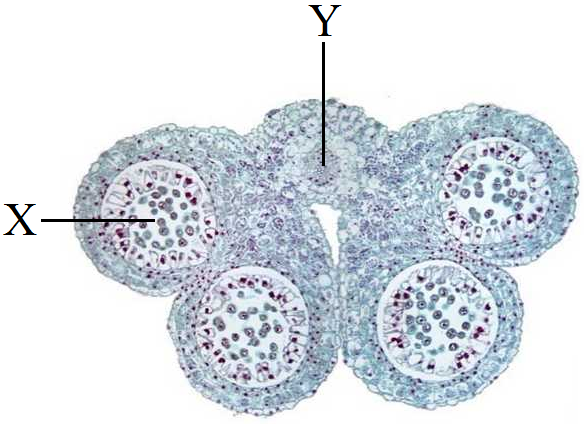
Many adaptations are found in flowers to achieve certain kind of pollination. The pollination achieved by insects is known as entomophily. The given diagram shows the cross-section of an anther of an insect pollinated flower.
  1. Which of the following is/ are the function $(s)$ of structure $Y$?
  1. To carry waste products away from the anther.
  2. To supply oxygen to the cells of the anther.
  3. To transport food and mineral salts to the anther.
  4. To supply water to the anther.
  1. Conly.
  2. $C$ and $D$ only.
  3. $A, B$ and $D$ only.
  4. $A, B, C$ and $D$.
  1. Which of the following most accurately describes the structures found in compartment $X$?
  1. They contain two haploid nuclei resulting from meiosis.
  2. They contain two haploid nuclei resulting from mitosis.
  3. They contain two haploid male gametes, resulting from mitosis.
  4. They contain a vegetative nucleus and pollen tube nucleus.
  1. Which of the following is a distinctive characteristic of insect $-$ pollinated flower?
  1. All of them have nectar guides on their flowers.
  2. They produce sugary fruit.
  3. Their pollen grains tend to have rough surfaces.
  4. They produce abundant quantities of pollen to make up for pollen grains that might be removed by the wind.
  1. Which of the following are likely characteristics of the structures found in $X$ and stamens of this plant?
S. No
Structure of $X$
Stamens
$(a)$
Abundant and light
Pendulous
$(b)$
Rough surfaces
Non $-$ pendulous
$(c)$
Light and sticky
Pendulous
$(d)$
Coarse and sticky
Protrude outside the flower
  1. Spiny or sticky pollen grains and large, attractively coloured flowers are associated with :
  1. Hydrophily.
  2. Entomophily.
  3. Ornithophily.
  4. Anemophily.
$\text{DNA}$ or $\text{RNA}$ segment tagged with a radioactive molecule is called $...........$
For question two statements are given $-$ one labelled Assertion and the other labelled Reason. Select the correct answer to these questions from the codes $(a), (b), (c)$ and $(d)$ as given below.
Assertion : Kangaroo rat can live without drinking water.
Reason : This is an adaptation to water scarcity in arid conditions.
Read the following and answer any four questions from $(i)$ to $(v)$ given below:
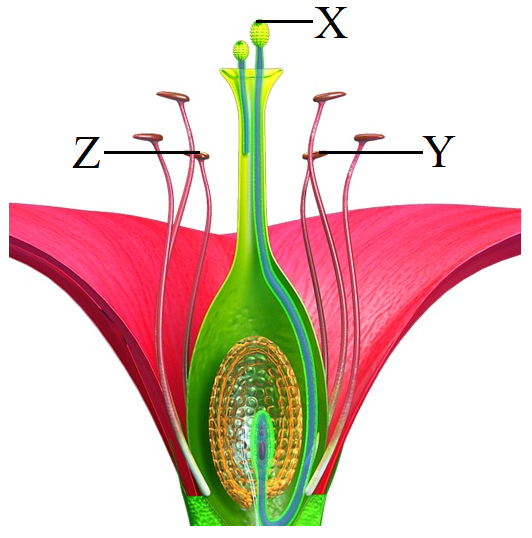
Cross pollination is the transfer of pollen grains from the anther of a one flower to the stigma of a genetically different flower. It is performed with the help of an external agency which may be abiotic $($e.g., wind, water$)$ or biotic $($e.g., insects, birds, bats, snails$)$. The diagram shows the carpel of an insect pollinated flower.
  1. What is the most likely reason for non germination of pollen grain $Z$ ?
  1. Pollen grains $X$ and $Y$ were brought to the stigma earlier, therefore, their germination inhibited the germination of pollen grain $Z$.
  2. Pollen grain $Z$ was brought to the flower by wind, while pollen grains $X$ and $Y$ were brought to the flower by insect.
  3. Pollen grain $Z$ lacks protrusions that allow it to adhere properly onto the stigma surface.
  4. Pollen grain $Z$ comes from a flower of an incompatible species.
  1. Which of the following best describes the function of the pollen tube?
  1. It acts as a conduit to transport male gametes from the anther to the ovule.
  2. It acts as a conduit to transport male gametes from the stigma to the ovule.
  3. It contains key nutrients that serve to nourish the newly $-$ formed zygote.
  4. It digests the tissues of the stigma, style, and ovary.
  1. Pollination of a flower in which the pollen is carried by an insect is called:
  1. Anemophily.
  2. Ornithophily.
  3. Entomophily.
  4. Malacophil.
  1. Refer to the given characteristics of some flowers.
  1. The stamens hang out of the flower, exposing the anthers to the wind.
  2. The pollen grains are tiny and light.
  3. The flower has a sweet scent.
  4. The flower petals are brightly colored.
  1. Pollenkitt is generally found in:
  1. Anemophilous flowers.
  2. Entomophilous flowers.
  3. Ornithophilous flowers.
  4. Malacophilous flowers.
For question two statements are given$-$one labelled Assertion and the other labelled Reason. Select the correct answer to these questions from the codes $(a), (b), (c)$ and $(d)$ as given below.
Assertion: The rate of extinction of organisms have increased in recent years.
Reason: Human activities like deforestation, industrialisation, etc., have destroyed the natural habitat of plants and animals.