MCQ
For rotational equilibrium,
  • A
    $\sum_{i=1}^n \tau_{\text {net }}=0$
  • B
    Both $\sum_{i=1}^n F _{\text {net }}=0$ and $\sum_{i=1}^n \tau_{\text {net }}=0$ are the necessary conditions for the rotational equilibrium
  • C
    Both $\sum_{i=1}^n F _{\text {net }}$ and $\sum_{i=1}^n \tau_{\text {net }}=0$ are not necessary for rotational equilibrium
  • D
    $\sum_{i=1}^n F _{\text {net }}=0$

Need a full question paper?

Generate a complete, print-ready paper with questions like this in minutes — across 16+ boards, with answer keys.

Start Generating Free

Similar questions

A missile is fired for maximum range at your town from a place $100\, km$ away from you. If the missile is first detected at its half way point, how much warning time will you have ? (Take $g = 10\, m/s^2$)
Under a pressure head the rate of orderly volume flow of a liquid through a capillary tube is $Q$ . If the length of capillary tube is doubled and the diameter of tube is halved, the rate of flow would become
A body moves a distance of $10 \,m$ along a straight line under the action of a force of $5 \,N$. If the work done is $25\, joules$, the angle which the force makes with the direction of motion of the body is.....$^o$
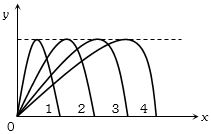
Figure shows four paths for a kicked football. Ignoring the effects of air on the flight, rank the paths according to initial horizontal velocity component, highest first
A person aiming to reach the exactly opposite point on the bank of a stream is swimming with a speed of $0.5\, m/s$ at an angle of $120^°$ with the direction of flow of water. The speed of water in the stream is..........$m/s$
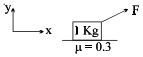
A $\vec F\,\, = \,\,\hat i\, + \,4\hat j\,$ acts on block shown. The force of friction acting on the block is :
Longitudinal stress of $1\,kg/m{m^2}$ is applied on a wire. The percentage increase in length is $(Y = {10^{11}}\,N/{m^2})$
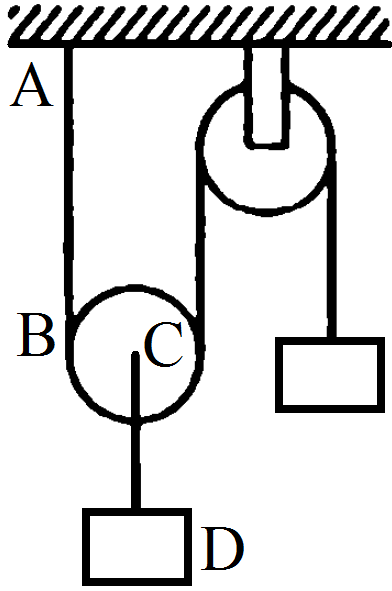
Both the strings, shown in figure are made of same material and have same cross$-$section. The pulleys are light. The wave speed of a transverse wave in the string $AB$ is $\nu_1$ and in $CD$ it is $\nu_2.$ Then $\frac{\nu_1}{\nu_2}$ is:
​​​​​​​
The specific heats, $C_P$ and $C_V$ of a gas of diatomic molecules, $A$, are given (in units of $J\, mol^{-1}\, K^{-1}$) by $29$ and $22$, respectively. Another gas of diatomic molecules $B$, has the corresponding values $30$ and $21$. If they are treated as ideal gases, then
A mass $m =100\, gms$ is attached at the end of a light spring which oscillates on a frictionless horizontal table with an amplitude equal to $0.16$ metre and time period equal to $2 \,sec$. Initially the mass is released from rest at $t = 0$ and displacement $x = - 0.16$ metre. The expression for the displacement of the mass at any time $t$ is