MCQ
For rotational equilibrium,
  • A
    $\sum^\limits{\text{n}}_\limits{\text{i}=1}\text{F}_{\text{net}}=0$
  • $\sum^\limits{\text{n}}_\limits{\text{i}=1}\tau_{\text{net}}=0$
  • C
    Both $(a)$ and $(b)$ are the necessary conditions for the rotational equilibrium.
  • D
    Both $(a)$ and $(b)$ are not necessary for rotational equilibrium.
Answer

Correct option: B.
$\sum^\limits{\text{n}}_\limits{\text{i}=1}\tau_{\text{net}}=0$

Need a full question paper?

Generate a complete, print-ready paper with questions like this in minutes — across 16+ boards, with answer keys.

Start Generating Free

Similar questions

Coefficient of linear expansion of brass and steel rods are $\alpha_1$ and $\alpha_2$. Lengths of brass and steel rods are $l_1$ and $l_2$ respectively. If $\left(l_2-l_1\right)$ is maintained same at all temperatures, which one of the following relations holds good?
The efficiency of carnot engine is $50\%$ and temperature of sink is $500\,K$ . If temperature of source is kept constant and its efficiency raised to $60\%$ , then the required temperature of the sink will be  .... $K$
A body rotating at $20\ rad/sec$ is acted upon by a constant torque providing it a deceleration of $2\ rad/sec^2$. At what time will the body have kinetic energy same as the initial value if the torque continues to act ...... $\sec.$
A rubber pipe of density $1.5 \times {10^3}\,N/{m^2}$ and Young's modulus $5 \times {10^6}\,N/{m^2}$ is suspended from the roof. The length of the pipe is $8 \,m$. What will be the change in length due to its own weight
Two particles of equal mass have velocities $2\,\hat i\, ms^{-1}$ and $2\,\hat j\, ms^{-1}$. First particle has an acceleration $(\,\hat i\, + \,\hat j\,)$ $ms^{-2}$ while the acceleration of the second particle is zero. The centre of mass of the two particles moves in
An open pipe of length $l$ vibrates in fundamental mode. The pressure variation is maximum at
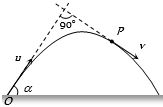
A body is projected with velocity $u$ making an angle $\alpha$ with the horizontal. Its velocity when it is perpendicular to the initial velocity vector $u$ is
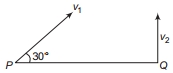
A projectile $A$ is thrown at an angle $30^{\circ}$ to the horizontal from point $P$. At the same time another projectile $B$ is thrown with velocity $v_2$ upwards from the point $Q$ vertically below the highest point $A$ would reach. For $B$ to collide with $A$, the ratio $\frac{v_2}{v_1}$ should be
A uniform chain of length $2\,m$ is kept on a table such that a length of $60\,cm$ hangs freely from the edge of the table. The total mass of the chain is $4\,kg$. What is the work done in pulling the entire chain on the table ................ $\mathrm{J}$
A spring mass system preforms $S.H.M.$ If the mass is doubled keeping amplitude same, then the total energy of $S.H.M.$ will become :