MCQ
For series $LCR$ circuit, wrong statement is
  • A
    Applied e.m.f. and potential difference across resistance are in same phase
  • B
    Applied $e.m.f$. and potential difference at inductor coil have phase difference of $\pi /2$
  • Potential difference at capacitor and inductor have phase difference of $\pi /2$
  • D
    Potential difference across resistance and capacitor have phase difference of $\pi /2$

Answer

Correct option: C.
Potential difference at capacitor and inductor have phase difference of $\pi /2$
c
For series $LCR$ circuit, potential difference at capacitor and inductor have phase difference of $\pi$.

Need a full question paper?

Generate a complete, print-ready paper with questions like this in minutes — across 16+ boards, with answer keys.

Start Generating Free

Similar questions

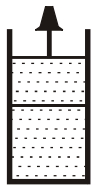
In the figure a container is shown to have a movable (without friction) piston on top. The container and the piston are all made of perfectly insulating material allowing no heat transfer between outside and inside the container. The container is divided into two compartments by a rigid partition made of a thermally conducting material that allows slow transfer of heat. The lower compartment of the container is filled with $2$ moles of an ideal monatomic gas at $700 \ K$ and the upper compartment is filled with $2$ moles of an ideal diatomic gas at $400$

K. The heat capacities per mole of an ideal monatomic gas are $C_v=\frac{3}{2} \ R, C_p=\frac{5}{2} R$, and those for an ideal diatomic gas are $C _{ v }=\frac{5}{2} \ R , C _{ P }=\frac{7}{2} R$.

$1.$ Consider the partition to be rigidly fixed so that it does not move. When equilibrium is achieved, the final temperature of the gases will be :

$(A)$ $550 \ K$ $(B)$ $525 \ K$ $(C)$ $513 \ K$ $(D)$ $490 \ K$

$2.$ Now consider the partition to be free to move without friction so that the pressure of gases in both compartments is the same. Then total work done by the gases till the time they achieve equilibrium will be:

$(A)$ $250 \ R$ $(B)$ $200 \ R$ $(C)$ $100 \ R$ $(D)$ $-100 \ R$

Give the answer question $1$ and $2.$
Zener breakdown occurs in a $p-n$ junction having $p$ and $n$ both :
An ideal gas mixture filled inside a balloon expands according to the relation $PV^{2/3} =$ constant. The temperature inside the balloon is
A $50\, g$ bullet moving with velocity $10\, m/s$ strikes a block of mass $950 \,g$ at rest and gets embedded in it. The loss in kinetic energy will be ............... $\%$
An object of mass $m$ is suspended at the end of a massless wire of length $L$ and area of cross$-$section, $A$. Young modulus of the material of the wire is $Y$. If the mass is pulled down slightly its frequency of oscillation along the vertical direction is
Two charge $ + \,q$ and $ - \,q$ are situated at a certain distance. At the point exactly midway between them
A sphere rolls down on an inclined plane of inclination $q$.  What is the acceleration as the sphere reaches bottom           
A strip of copper and another of germanium are cooled from room temperature to $80\, K$. The resistance of
We have three identical metallic spheres $A, B$ and $C$. $A$ is given a charge $Q$, and $B$ and $C$ are uncharged. The following processes of touching of two spheres are carried out in succession. Each process is carried out with sufficient time.
$(i)$ $A$ and $B$      $(ii)$ $B$ and $C$
$(iii)$ $C$ and $A$      $(iv)$ $A$ and $B$
$(v)$ $B$ and $C$
The final charges on the spheres are
Consider a hypothetical annihilation of a stationary electron with a stationary positron. What is the wavelength of resulting radiation.

($h =$ Plank’s constant, $c =$ speed of light, $m_0 =$ rest mass)