MCQ
For small currents, $‘X’$ obeys Ohm’s law. But when large currents are passed through the same conductor, it deviates from ohmic behaviour. Identify $X.$
  • Metallic conductor.
  • B
    Gallium arsenide.
  • C
    Thyristor.
  • D
    $p-n$ junction diode.

Answer

Correct option: A.
Metallic conductor.

$‘X\ ’$ is a metallic conductor. For small currents, it obeys Ohms’s law and its $V-I$ graph is a straight line. But when large currents are passed through the same conductor, it gets heated up and its resistance increases. It no longer obeys Ohm’s law at higher currents.

Need a full question paper?

Generate a complete, print-ready paper with questions like this in minutes — across 16+ boards, with answer keys.
Start Generating Free

Similar questions

Which of the following are conservative forces:
The voltage of an ac source varies with time according to the equation $V = 100\sin \;100\pi t\,\cos \,100\pi t$ where $t$ is in seconds and $V$ is in volts. Then
If three capacitors each of capacity $1\,\mu F$ are connected in such a way that the resultant capacity is $1.5\,\mu F$, then
In Rutherford's $\alpha$-scattering experiment, if atomic number increases with thin metal foil then scattering angle is :
The wavelength of the first line of Balmer series is 6563 $A^0$. The Rydberg constant for hydrogen is about
A charge is brought from a point on the equatorial plane of a dipole to its mid-point. Which of the following quantities remains constant?
The fringe width in a $YDSE$ pattern is $2.4\times10^{-4}\, m$ when red light of wavelength $6400\,\mathop A\limits^o $ is used. How much will it change, if blue light of wavelength $4000\,\mathop A\limits^o $ is used
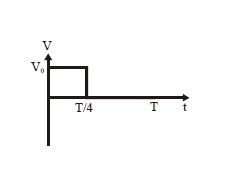
A periodic voltage $V$ varies with time $t$ as shown in the figure. $T$ is the time period. The $r.m.s$. value of the voltage is :-
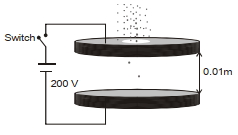
Two large circular discs separated by a distance of $0.01 m$ are connected to a battery via a switch as shown in the figure. Charged oil drops of density $900 kg m ^{-3}$ are released through a tiny hole at the center of the top disc. Once some oil drops achieve terminal velocity, the switch is closed to apply a voltage of $200 V$ across the discs. As a result, an oil drop of radius $8 \times 10^{-7} m$ stops moving vertically and floats between the discs. The number of electrons present in this oil drop is (neglect the buoyancy force, take acceleration due to gravity $=10 ms ^{-2}$ and charge on an electron ($e$) $=1.6 \times 10^{-19} C$ )
Which of the following statement$(s)$ is/ are correct?