Question
For the $\beta^{+}$ (positron) emission from a nucleus, there is another competing process known as electron capture (electron from an inner orbit, say, the K–shell, is captured by the nucleus and a neutrino is emitted).
$\text{e}^{+}+^{\text{A}}_{\text{Z}}\text{X}\rightarrow\ ^{\text{A}}_{\text{Z}-1}\text{Y}+\text{v}$
Show that if $\beta^{+}$ emission is energetically allowed, electron capture is necessarily allowed but not vice–versa.
Answer

Let the amount of energy released during the electron capture process be Q1. The nuclear reaction can be written as:
$\text{e}^{+}+^{\text{A}}_{\text{Z}}\text{X}\rightarrow^{\text{A}}_{\text{Z}-1}\text{Y}+\text{v}+\text{Q}_1\ \dots(1)$
Let the amount of energy released during the positron capture process be Q2. The nuclear reaction can be written as:
$^{\text{A}}_{\text{Z}}\text{X}\rightarrow^{\text{A}}_{\text{Z}-1}\text{Y}+\text{e}^{+}+\text{v}+\text{Q}_2\ \dots(2)$
$\text{m}_\text{N}(^{\text{A}}_{\text{Z}}\text{X})$ = Nuclear mass of $^{\text{A}}_{\text{Z}}\text{X}$
$\text{m}_\text{N}(_{\text{Z}-1}^\text{A}\text{Y})$ = Nuclear mass of $_{\text{Z}-1}^{\text{A}}\text{Y}$
$\text{m}(^{\text{A}}_{\text{Z}}\text{X})$ = Atomic mass of $^\text{A}_\text{Z}\text{X}$
$\text{m}(^{\text{A}}_{\text{Z}-1}\text{Y})$ = Atomic mass of $^{\text{A}}_{\text{Z}-1}\text{Y}$
me = Mass of an electron
c = Speed of light
Q-value of the electron capture reaction is given as:
$\text{Q}_1=\Big[\text{m}_{\text{N}}(^{\text{A}}_{\text{Z}}\text{X})+\text{m}_{\text{e}}-\text{m}_{\text{N}}(^{\text{A}}_{\text{Z}-1}\text{Y})\Big]\text{c}^2$
$=\Big[\text{m}(^{\text{A}}_{\text{Z}}\text{X})-\text{Zm}_\text{e}+\text{m}_\text{e}-\text{m}(^{\text{A}}_{\text{Z}-1}\text{Y})+(\text{Z}-1)\text{m}_\text{e}\Big]\text{c}^2$
$=\Big[\text{m}(^{\text{A}}_{\text{Z}}\text{X})-\text{m}(^{\text{A}}_{\text{Z}-1}\text{Y})\Big]\text{c}^2$
Q-value of the positron capture reaction is given as:
$\text{Q}_2=\Big[\text{m}_{\text{N}}(^{\text{A}}_{\text{Z}}\text{X})-\text{m}_{\text{N}}(^{\text{A}}_{\text{Z}-1}\text{Y})-\text{m}_\text{e}\Big]\text{c}^2$
$=\Big[\text{m}(^{\text{A}}_{\text{Z}}\text{X})-\text{Zm}_\text{e}-\text{m}(^{\text{A}}_{\text{Z}-1}\text{Y})+(\text{Z}-1)\text{m}_\text{e}-\text{m}_\text{e}\Big]\text{c}^2$
$=\Big[\text{m}(^{\text{A}}_{\text{Z}}\text{X})-\text{m}(^{\text{A}}_{\text{Z}-1}\text{Y})-2\text{m}_\text{e}\Big]\text{c}^2$
It can be inferred that if Q> 0, then Q1 > 0; Also, if Q1 > 0, it does not necessarily mean that Q2 > 0.

Need a full question paper?

Generate a complete, print-ready paper with questions like this in minutes — across 16+ boards, with answer keys.

Start Generating Free

Similar questions

State Biot-Savart statement. Obtain an expression for produced magnetic field due to a straight and limited length of current carrying conductor wire. Write its similarities and differences with coulomb's law of electrostatics.
A car accelerates on a horizontal road due to the force exerted by:
  1. The engine of the car.
  2. The driver of the car.
  3. The earth.
  4. The road.
A point object is placed at a distance of 15cm from a convex lens. The image is formed on the other side at a distance of 30cm from the lens. When a concave lens is placed in contact with the convex lens, the image shifts away further by 30cm. Calculate the focal lengths of the two lenses.
  1. Draw the circuit diagrams of a p-n junction diode in (i) forward bias, (ii) reverse bias. How are these circuits used to study the V - I characteristics of a silicon diode? Draw the typical V - I characteristics.
  2. What is a light emitting diode (LED)? Mention two important advantages of LEDs over conventional lamps.
Consider an excited hydrogen atom in state n moving with a velocity u(ν << c). It emits a photon in the direction of its motion and changes its state to a lower state m. Apply momentum and energy conservation principles to calculate the frequency ν of the emitted radiation. Compare this with the frequency ν0 emitted if the atom were at rest.
  1. Write the expression for the force, $\overrightarrow{\text{F}}$, acting on a charged particle of charge 'q', moving with a velocity$\overrightarrow{\text{v}}$ in the presence of both electric field $\overrightarrow{\text{E}}$and magnetic field $\overrightarrow{\text{B}}.$ Obtain the condition under which the particle moves undeflected through the fields.
  2. A rectangular loop of size l x b carrying a steady current I is placed in a uniform magnetic field $\overrightarrow{\text{B}}.$ Prove that the torque$\overrightarrow{\tau}$ acting on the loop is given by $\overrightarrow{\tau} =\overrightarrow{\text{m}}\times\overrightarrow{\text{B},}$were $\overrightarrow{\text{m}}$is the magnetic moment of the loop.
Write the statement of Gauss's law for electrostatics. Draw a diagram and derive an expression for the electric field due to a uniformly charged infinite plane sheet at a point near it.In the given figure, write the value of electric flux emerging from the surface :

Image
A long, straight wire carries a current i. Let B1, be the magnetic field at a point Pat a distance d from the wire. Consider a section of length l of this wire such that the point P lies on a perpendicular bisector of the section. Let B2 be the magnetic field at this point due to this section only. Find the value of $\frac{\text{d}}{\text{l}}$ so that B2 differs from B1, by 1%.
The first four spectral lines in the Lyman serics of a H-atom are λ = 1218Å, 1028Å, 974.3Å and 951.4Å. If instead of Hydrogen, we consider Deuterium, calculate the shift in the wavelength of these lines.
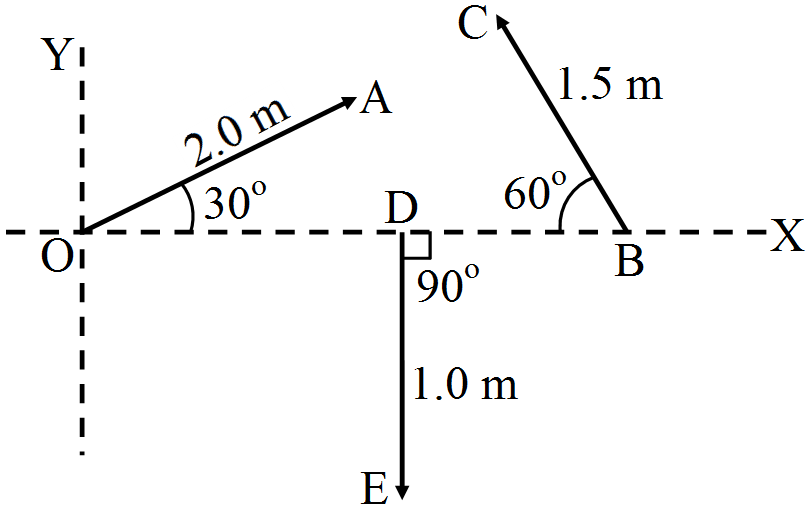
Refer to figure. Find
  1. The magnitude.
  2. x and y components
  3. The angle with the X-axis of the resultant of $\overrightarrow{\text{OA}},\overrightarrow{\text{BC}}$ and $\overrightarrow{\text{DE}}.$