MCQ
For the chemical equilibrium, $CaC{{O}_{3}}_{(s)})$ $\rightleftharpoons$ $CaO_{(s)}+C{{O}_{2}}_{(g)},\ \Delta H_{r}^{{}^\circ }$ can be determined from which one of the following plots
- ✓
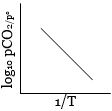
- B
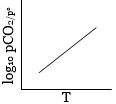
- C
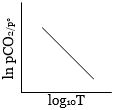
- D
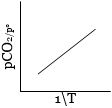
$CaCO_{3(g)} \rightleftharpoons CaO_{(s)} + CO_{2(g)}$
$K_p = P_{CO_2}$ and $K_C = [CO_2]$
$(\because [CaCO_3] = 1$ and $[CaO] = 1$ for solids$)$
According to Arrhenius equation we have
$K = A{e^{ - \Delta H{^\circ _r}/RT}}$
Taking logarithm, we have
$\log {K_p} = \log\, A - \frac{{\Delta H_r^o}}{{RT(2.303)}}$
This is an equation of straight line. When $log \,K_p$ is plotted against $1 / T$. we get a straight line.
The intercept of this line = $ log \,A$, slope $= -\Delta H^°_r / 2.303 \,R$
Knowing the value of slope from the plot and universal gas constant $R$, $∆H^°_r$ can be calculated.
(Equation of straight line : $Y = mx + C$. Here,
$\log {K_p} = - \frac{{\Delta H_r^o}}{{2.303R}}\left( {\frac{1}{T}} \right) + \log A$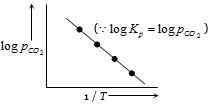
Generate a complete, print-ready paper with questions like this in minutes — across 16+ boards, with answer keys.
$(i) C_2H_5OH \longrightarrow CH_3CHO$
$(ii) C_2H_5OH \longrightarrow C_2H_5ONa$