MCQ
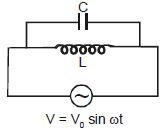
For the circuit shown in the fig., the current through the inductor is $0.9\,A$ while the current through the condenser is $0.4\,A$. Then
  • A
    current drawn from generator $I = 1.13 \,A$
  • B
    $\omega = 1/(1.5\,LC)$
  • $I = 0.5\, A$
  • D
    $I = 0.6\, A$

Answer

Correct option: C.
$I = 0.5\, A$
c
The current drawn by inductor and capacitor will be in opposite phase. Hence net current drawn from generator

$= I_L -I_C = 0.9 -0.4 = 0.5\,amp.$

Need a full question paper?

Generate a complete, print-ready paper with questions like this in minutes — across 16+ boards, with answer keys.
Start Generating Free

Similar questions

In nuclear fission, the fission reactions proceeds with a projectile. Which of the following suits the best
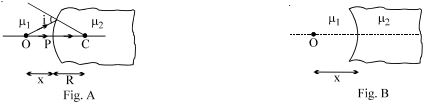
$A$ curved surface of radius $R$ separates two medium of refractive indices $\mu_1$ and $\mu_2$ as shown in figures $A$ and $B$ Choose the correct statement $(s)$ related to the virtual image formed by object $O$ placed at a distance $x$, as shown in figure $A$
The ratio of momenta of an electron and an $\alpha - $particle which are accelerated from rest by a potential difference of $100 V$ is
The photoelectric effect is based on the law of conservationof:
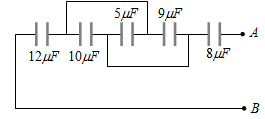
The capacities and connection of five capacitors are shown in the adjoining figure. The potential difference between the points A and B is 60 volts . Then the equivalent capacity between A and B and the charge on 5μF capacitance will be respectively
Number of secondary electrons emitted per number of primary electrons depends on
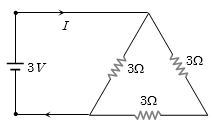
A $3\, volt$ battery with negligible internal resistance is connected in a circuit as shown in the figure. The current $I$, in the circuit will be ............. $A$
At room temperature, copper has free electron density of $8.4 \times {10^{28}}$ per ${m^3}$. The copper conductor has a cross-section of $10^{-6} \,m^2$ and carries a current of $5.4\, A$. The electron drift velocity in copper is
The essential distinction between $X-$ rays and $\gamma - $ rays is that
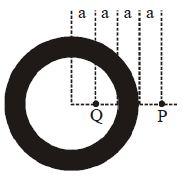
A solid uncharged conducting sphere has radius $3a$ contains a hollowed spherical region of radius $2a$. A point charge $+Q$ is placed at a position a distance a from the common center of the spheres. What is the magnitude of the electric field at the position $r = 4a$ from the center of the spheres as marked in the figure by $P?$ $\left( {k = \frac{1}{{4\pi { \in _0}}}} \right)$