For the circuit shown in the figure
$(A)$ the current $I$ through the battery is $7.5 \mathrm{~mA}$
$(B)$ the potential difference across $R_{\mathrm{L}}$, is $18 \mathrm{~V}$
$(C)$ ratio of powers dissipated in $R_1$ and $R_2$ is $3$
$(D)$ if $R_1$ and $R_2$ are interchanged, magnitude of the power dissipated in $R_{\mathrm{L}}$ will decrease by a factor of $9$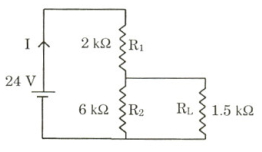
IIT 2009, Diffcult


Download our appand get started for free
Experience the future of education. Simply download our apps or reach out to us for more information. Let's shape the future of learning together!No signup needed.*
Similar Questions
- 1The emf of a battery is $2\, V$ and its internal resistance is $0.5 \,\Omega$. The maximum power which it can deliver to any external circuit will be ............. $watt$View Solution
- 2An electric fan and a heater are marked as $100\, watt$, $220\, volt$ and $1000\, watt$, $220\, volt$ respectively. The resistance of the heater isView Solution
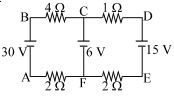
- 3The figure shows a network of four resistances and three batteries The electrical power dissipated as heat is .............. $W$View Solution
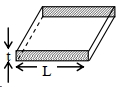
- 4Consider a thin square sheet of side $\mathrm{L}$ and thickness $\mathrm{t}$, made of a material of resistivity $\rho$. The resistance between two opposite faces, shown by the shaded areas in the figure isView Solution
- 5The same mass of copper is drawn into two wires $1\, mm$ and $2\, mm$ thick. Two wires are connected in series and current is passed through them. Heat produced in the wire is in the ratioView Solution
- 6A battery of $24$ cells, each of emf $1.5\, V$ and internal resistance $2\, \Omega$ is to be connected in order to send the maximum current through a $12 \,\Omega$ resistor. The correct arrangement of cells will beView Solution
- 7Two cells, $e.m.f.$ of each is $E$ and internal resistance $r$ are connected in parallel between the resistance $R$. The maximum energy given to the resistor will be, only whenView Solution
- 8View SolutionIn meter bridge or Wheatstone bridge for measurement of resistance, the known and the unknown resistances are interchanged. The error so removed is
- 9In a potentiometer circuit a cell of $EMF$ $1.5\, {V}$ gives balance point at $36\, {cm}$ length of wire. If another cell of $EMF$ $2.5\, {V}$ replaces the first cell, then at what length of the wire, the balance point occurs ? (in $cm$)View Solution
- 10Four resistances of $100$ $\Omega$ each are connected in the form of square. Then, the effective resistance along the diagonal points is .............. $\Omega$View Solution