In a potentiometer circuit a cell of $EMF$ $1.5\, {V}$ gives balance point at $36\, {cm}$ length of wire. If another cell of $EMF$ $2.5\, {V}$ replaces the first cell, then at what length of the wire, the balance point occurs ? (in $cm$)
NEET 2021, Medium


Download our appand get started for free
Experience the future of education. Simply download our apps or reach out to us for more information. Let's shape the future of learning together!No signup needed.*
Similar Questions
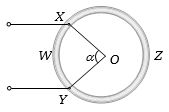
- 1A wire of resistor $R$ is bent into a circular ring of radius $r$. Equivalent resistance between two points $X$ and $Y$ on its circumference, when angle $XOY$ is $\alpha$, can be given byView Solution
- 2View SolutionIf an observer is moving with respect to a stationary electron, then he observes
- 3In a wire of cross section radius $r,$ free electrons travel with drift velocity $v$ when a current $I$ flows through the wire. What is the current in another wire of half the radius and of the same material when the drift velocity is $2v$ ?View Solution
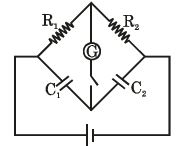
- 4View SolutionCircuit shown is in steady state, now when switch is closed, galvanometer shows no deflection, then correct relation is
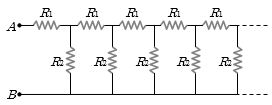
- 5An infinite sequence of resistance is shown in the figure. The resultant resistance between $A$ and $B$ will be, when ${R_1} = 1\,ohm$ and ${R_2} = 2\,ohm$ ............. $\Omega$View Solution
- 6A heating coil can heat the water of a vessel from $20\,^oC$ to $60\,^oC$ in $30$ minutes. Two such heating coils are put in series and then used to heat the same amount of water through the same temperature range. The time taken now will be ............ $min$ (neglecting thermal capacity of the coils)View Solution
- 7A cell of internal resistance $3\, ohm$ and $emf$ $10\, volt$ is connected to a uniform wire of length $500 \,cm$ and resistance $3\, ohm$. The potential gradient in the wire is .............. $mV/cm$View Solution
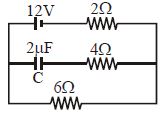
- 8Find the charge on the capacitor $C$ in the following circuit ............. $\mu C$View Solution
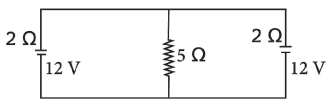
- 9In the arrangement shown in figure, the current through $5\,\Omega$ resistor is ............. $A$View Solution
- 10A potentiometer having the potential gradient of $2\, mV/cm$ is used to measure the difference of potential across a resistance of $10 \,\Omega$. If a length of $50\, cm$ of the potentiometer wire is required to get the null point, the current passing through the $10 \,\Omega$ resistor is (in $mA$)View Solution