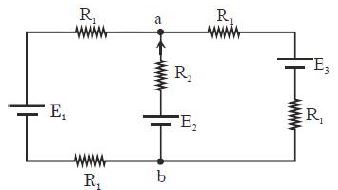
For the circuit shown, with ${R_1} = 1.0\,\Omega $, ${R_2} = 2.0\,\Omega $, ${E_1} = 2\,V$ and ${E_2} = {E_3} = 4\,V$, the potential difference between the points $‘a’$ and $‘b’$ is approximately (in $V$)
JEE MAIN 2019, Medium
Download our app for free and get started
$ E_{e q}= \frac{\frac{E_{1}}{2 R_{1}}+\frac{E_{2}}{R_{2}}+\frac{E_{3}}{2 R_{1}}}{\frac{1}{2 R_{1}}+\frac{1}{R_{2}}+\frac{1}{2 R_{1}}} $
$ = \frac{{\frac{2}{2} + \frac{4}{2} + \frac{4}{2}}}{{\frac{1}{2} + \frac{1}{2} + \frac{1}{2}}} = \frac{5}{{\frac{3}{2}}} = \frac{{10}}{3} = 3.3$

Download our appand get started for free
Experience the future of education. Simply download our apps or reach out to us for more information. Let's shape the future of learning together!No signup needed.*
Similar Questions
- 1First, a set of ${n}$ equal resistors of $10\; \Omega$ each are connected in series to a battery of emf $20\; {V}$ and internal resistance $10\; \Omega .$ A current $I$ is observed to flow. Then, the $n$ resistors are connected in parallel to the same battery. It is observed that the current is increased $20$ times, then the value of $n$ is .... .View Solution
- 2View SolutionThe positive temperature coefficient of resistance is for
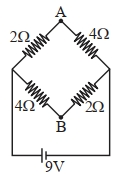
- 3View SolutionIn potentiometer a balance point is obtained, when
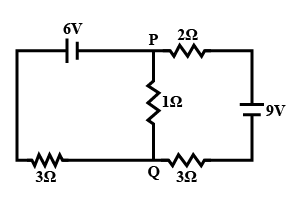
- 4In the circuit shown, the current in the $1\,\Omega$ resistor isView Solution
- 5A potentiometer wire is $100\,\, cm$ long and a constant potential difference is maintained across it. Two cells are connected in series first to support one another and then in opposite direction. The balance points are obtained at $50\,\, cm$ and $10\,\, cm$ from the positive end of the wire in the two cases. The ratio of emf's isView Solution
- 6A battery consists of a variable number '$n$' of identical cells having internal resistances connected in series. The terminals of battery are short circuited and the current $i$ is measured. Which of the graph below shows the relation ship between $i$ and $n$View Solution
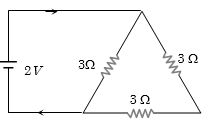
- 7The current in the following circuit is ........... $A$View Solution
- 8A potential difference of $10 \,V$ is applied across a conductor of $1000 \,\Omega$. The number of electrons flowing through the conductor in $300 \,s$ is ..........View Solution
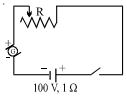
- 9The battery in the diagram is to be charged by the generator $G$. The generator has a terminal voltage of $120$ $\mathrm{volts}$ when the charging current is $10$ $\mathrm{amperes}.$ The battery has an $\mathrm{emf}$ of $100$ $\mathrm{volts}$ and an internal resistance of $1$ $\mathrm{ohm}.$ In order to charge the battery at $10$ $\mathrm{amperes}$ charging current, the resistance $R$ should be set at ................ $\Omega$View Solution
- 10A network of four resistances is connected to $9\,V$ battery, as shown in figure. The magnitude of voltage difference between the points $A$ and $B$ is .......... $V.$View Solution