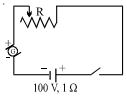
The battery in the diagram is to be charged by the generator $G$. The generator has a terminal voltage of $120$ $\mathrm{volts}$ when the charging current is $10$ $\mathrm{amperes}.$ The battery has an $\mathrm{emf}$ of $100$ $\mathrm{volts}$ and an internal resistance of $1$ $\mathrm{ohm}.$ In order to charge the battery at $10$ $\mathrm{amperes}$ charging current, the resistance $R$ should be set at ................ $\Omega$
Medium


Download our appand get started for free
Experience the future of education. Simply download our apps or reach out to us for more information. Let's shape the future of learning together!No signup needed.*
Similar Questions
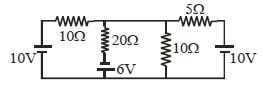
- 1The value of current through $20\,\Omega $ resistor is .................. $A$View Solution
- 2Consider the circuit shown below where all resistors are $1 \,k \Omega$. If a current of magnitude $1 \,mA$ flows through the resistor marked $X$, the potential difference measured between points $P$ and $Q$ are ..............$V$View Solution
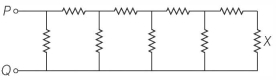
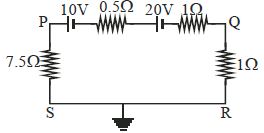
- 3View SolutionIn the circuit shown in figure, which of the statement is incorrect ?
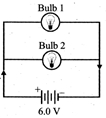
- 4A $6.0\,volt$ battery is connected to two light bulbs as shown in figure. Light bulb $1$ has resistance $3\,ohm$ while light bulb $2$ has resistance $6\,ohm.$ Battery has negligible internal resistance. Which bulb will glow brighter?View Solution
- 5Consider a wire having current $10\,A$ having area of crossection $1\,cm^2$. If number of electrons per unit volume is $9 \times 10^{28}\, m^{-3}$. Find the drift velocity of electronsView Solution
- 6The resistance of a wire is $20\, ohms$. It is so stretched that the length becomes three times, then the new resistance of the wire will be ............. $ohms$View Solution
- 7View SolutionWhich of the following statement is false
- 8There are $n$ similar conductors each of resistance $R$. The resultant resistance comes out to be $x$ when connected in parallel. If they are connected in series, the resistance comes out to beView Solution
- 9The resistor of resistance '$R$' is connected to $25\, V$ supply and heat produced in it is $25\, J/sec$. The value of $R$ is .......... $\Omega $View Solution
- 10In an experiment of potentiometer for measuring the internal resistance of primary cell a balancing length $\ell $ is obtained on the potentiometer wire when the cell is open circuit. Now the cell is short circuited by a resistance $R$. If $R$ is to be equal to the internal resistance of the cell the balancing length on the potentiometer wire will beView Solution