MCQ
For the following Assertion and Reason, the correct option is

Assertion : The $pH$ of water increases with increase in temperature.

Reason : The dissociation of water into $H^+$ and $OH^-$ is an exothermic reaction.

  • A
    Both assertion and reason are true, but the reason is not the correct explanation for the assertion.
  • Both assertion and reason are false.
  • C
    Assertion is not true, but reason is true.
  • D
    Both assertion and reason are true, and the reason is the correct explanation for the assertion.

Answer

Correct option: B.
Both assertion and reason are false.
b
$\mathrm{H}_{2} \mathrm{O}(\ell) \rightleftharpoons \mathrm{H}_{(\mathrm{aq})}^{+}+\mathrm{OH}_{(\mathrm{aq})}^{-}$

For ionization of $\mathrm{H}_{2} \mathrm{O}: \Delta \mathrm{H}>\mathrm{O}$ $\Rightarrow$ Endothermic

On temperature increase reaction shifts forward

$\Rightarrow$ both $\left[\mathrm{H}^{+}\right]$ and $\left[\mathrm{OH}^{-}\right]$ increase

$\Rightarrow \mathrm{pH} \;and\; \mathrm{pOH}$ decreases.

Need a full question paper?

Generate a complete, print-ready paper with questions like this in minutes — across 16+ boards, with answer keys.

Start Generating Free

Similar questions

Assertion : For a reaction $2NH_3(g) \to N_2(g) + 3H_2 (g)$ ; $\Delta H > \Delta E$.
Reason : Enthalpy change is always greater than internal energy change.
All members of a homologous series differ by a :
The electron density between $1s$ and $2s$ orbital is
An irreversible process occuring isothermally in an isolated system leads to
The Bohr model of atoms :
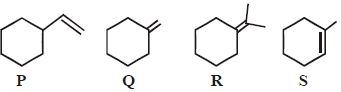
Arrange the following alkenes in increasing order of their enthalpy of hydrogenation $(-\Delta H)$
In the following acid-base reaction, in which can backward reaction if favoured?
The interatomic distances in ${H_2}$ and $C{l_2}$ molecules are $74$ and $198$ $pm$ respectively. The bond length of $HCl$ is ............. $\mathrm{pm}$
Which of the following is not the use of $\ce{H_2​O_2}$ in the environmental chemistry?
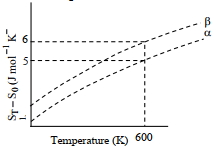
The entropy versus temperature plot for phases $\alpha$ and $\beta$ at 1 bar pressure is given. $S_{\mathrm{T}}$ and $S_0$ are entropies of the phases at temperatures $\mathrm{T}$ and $0 \mathrm{~K}$, respectively.

(image)

The transition temperature for $\alpha$ to $\beta$ phase change is $600 \mathrm{~K}$ and $C_{p, \beta}-C_{p, \alpha}=1 \mathrm{~J} \mathrm{~mol}^{-1} \mathrm{~K}^{-1}$. Assume $\left(C_{p, \beta}-C_{p, \alpha}\right)$ is independent of temperature in the range of 200 to $700 \mathrm{~K} . \mathrm{C}_{p, \alpha}$ and $C_{p, \beta}$ are heat capacities of $\alpha$ and $\beta$ phases, respectively.

($1$)The value of entropy change, $\mathrm{S}_\beta-\mathrm{S}_\alpha$ (in $\mathrm{J} \mathrm{mol}^{-1} \mathrm{~K}^{-1}$ ), at $300 \mathrm{~K}$ is. . . . . . .

[Use : $\ln 2=0.69$  Given : $S_\beta-S_\alpha=0$ at $\left.0 \mathrm{~K}\right]$

($2$) The value of enthalpy change, $\mathrm{H}_\beta-\mathrm{H}_\alpha$ (in $J$ mol ${ }^{-1}$ ), at $300 \mathrm{~K}$ is

Give the answer quetion ($1$) and ($2$)